Release: The Dark Continent (A Bridge Between Worlds 4)

Halfway across the bridge now, and we’re still going strong.

For Damonte, crossing the bridge between worlds was like going back in time. Choosing not to return home was one of the hardest sacrifices he had ever made. But it might be for the best. Here in this world, among a different sort of people, he has a chance. A chance to make a difference, a chance to right a wrong. A chance not only to be free, but to truly understand what freedom means.

The Otherworld series remains exclusive to my Patreon, and you can pick up this installment, as well as the rest of the story, for a pledge of only a few dollars a month.

A Bridge Between Worlds continues with Part 5, “The Lessons Learned”, coming September 25. Check back for more info, and remember to keep reading!

On the weather

It’s hot right now. Maybe not where you live, maybe not when you’re reading this, but today, for me, is a hot, steamy day on the edge of summer. There’s a slight chance of thunderstorms; I can see them on the local radar, and I’d give them 50-50 odds of getting here before they die down for the day.

Weather is an important part of our lives. Unless you live in an underground bunker or a climate-controlled habitat dome (Fallout and Surviving Mars fans can speak up here), you have to deal with it on a daily basis. Some of humanity’s first attempts at controlling the future were purely for the weather: winds, tides, rains, and storms. We go to great lengths to forecast it, and it’s so ingrained in our culture that the most generic icebreaker we have is “How about that weather?”

For storytelling purposes, weather is mostly background information. You don’t even have to put it in, really; it’s assumed to be a sunny day (or clear night) unless stated otherwise. But a little bit of inclement weather can serve a purpose, if thrown in at the right time.

Have you ever seen the rain

Rain, of course, is the most obvious type of “bad” weather. We associate rainy days with dreariness, lethargy, and sadness. Harder rains can cause flooding, while a mere drizzle does nothing but annoy.

But that’s a bit biased. In temperate regions (like most of the US and Europe), rain can fall at any time throughout the year. Warm and cold fronts bring rain, and tropical cyclones can produce massive amounts. That’s how weather works around here. In tropical regions, however, you’re more likely to have distinct wet and dry seasons. The wet season, often what would be “winter”, can see daily showers and light thunderstorms. In contrast, the dry season is, well, dry. Some places, even in rainforests, can go months without even a trace of rainfall. Out-of-season rain is an event for these locales, and it’s usually caused by a storm—in fantasy, there might even be ulterior motives.

Most of all, rain sets a tone for a scene. A rainy day is…blah. You don’t want to go outside. All you want to do is either sleep or stare out the window. That’s a great time for introspection, dialogue, and all the hallmarks of what TV writers call the “bottle” episode. Your characters are stuck together, so now’s the time to let it all out.

The thunder rolls

Beyond rain, we have the thunderstorm. (Okay, some storms don’t have rainfall, or they have the virga phenomenon, where the rain evaporates before it reaches the ground. Bear with me here.) Storms produce lighting, which then creates thunder. Larger ones can drop hail, ranging from tiny pellets to softball-sized chunks of ice. Depending on where you—or your characters—live, tornadoes are also a possibility.

A thunderstorm represents violence, the fury of nature. It’s a good time for characters to wonder if the world is mad at them specifically. The aftermath brings a chance to spot and repair damage, as some severe thunderstorms and tornadoes can destroy houses, knock down trees and power lines, etc. A few, alas, are even deadly. (I used a killer storm in Written in Black and White, for instance.) If you can’t find a story in the tornado outbreaks that struck Joplin, Missouri or Ringgold, Georgia, a few years ago, then I don’t know what to tell you.

Lightning also kills, though that’s rarer. In fantasy settings, especially those with active deities, that might also provide a bit of a hook. For the sci-fi side of the coin, consider the more extreme storms that could occur on other worlds. I don’t just mean the Great Red Spot here; Earthlike planets with thicker atmospheres, for example, would certainly have stronger winds in their storms.

Let it snow

I’m a kid at heart, so snow is obviously my favorite sort of inclement weather. It’s got all the same downsides as rain, but add to those the cold, the lack of traction on icy roads, and sheer weight. Then again, it also gives us snowball fights, snowmen, sledding, skiing, and so on. For children, snow is fun. For the working man, it’s terrible. A perfect dichotomy, if you ask me.

Heavier snowfalls do the same thing as heavy rains and severe storms: keep people inside. (Sometimes, it keeps them inside for far too long. Look at, say, the Donner Party.) But where a thunderstorm usually lasts only an hour or two at most, the aftermath of a blizzard can stick around for a week or more. In places that don’t often see large amounts of snow (like Tennessee in 1993), that causes massive headaches for the populace. Set in older days, before technology allowed us to store over a week of food without trouble, you have an even bigger problem. A two-foot blanket of snow in a place that wasn’t expecting it could be the prelude to a disaster. And speaking of disasters…

The weather outside is frightful

Some of our most destructive disasters stem from the weather. Tornado outbreaks strike across the Great Plains in the US and Canada, sometimes also creeping into the American Southeast. I know those all too well: one 2011 twister touched down less than a mile from my house. Hurricanes and tropical storms, not as common in Europe or on the West Coast, strike the eastern US fairly often. We all remember Katrina and the others from the wild 2005 season, but every portion of the coast has a tale from Andrew, Hugo, Camille, Opal, Rita, or one of the many other retired names on the NHC list.

A true weather disaster is a story in itself, but it can also provide the impetus or backdrop for a story. The storm might be on the periphery, but it will affect the characters even from a great distance. News reports trickle in, loved ones may ask for help—you get the idea. All you have to do is turn on the TV or check the Internet to see what happens when a natural disaster strikes.

And that really goes for anything to do with the weather. We’ve got sites and channels dedicated to nothing else. You can’t miss it. The hard part is figuring out how to integrate it with your story. The first question to ask there has to be: do you need to? Maybe it’s enough to say that it was a cloudy day, or that rain was striking the roof.

If that’s not the case, and you do need a storm to spice things up, think about what they do in real life. They bring people together, either physically (because it’s too dangerous to be outside) or emotionally (every major disaster brings out the charitable contributions). They can destroy homes, change lives. But they can also be a time to shine. We can always find the hero who threw himself atop his kids so the tornado would take him instead, or the boater who made six trips to the houses of flood victims, or whatever you’re looking for.

Or it might just be a little rain. That wouldn’t hurt.

On lunar exploration

The Moon. Our closest celestial neighbor, the body that gives light to our nights. We’re coming up on the 50th anniversary of mankind’s greatest achievement: walking upon that body. And we’re losing the heroes who accomplished that feat. With the recent death of Alan Bean, only 4 of the 12 remain alive.

Something must be done on that front. We can’t let the direct, personal exploration of our natural satellite pass out of living memory. Some private corporations (e.g., SpaceX, Boeing) are looking into the matter. Next July would be a fantastic time to make a power move in that space race.

But let’s take a step back, look at exploring the Moon from a storytelling perspective. That is, after all, what we do here. For the budding author of science fiction, dear Luna presents an interesting setting not entirely unlike Earth’s deserts, the deepest ocean trenches, or the vast emptiness of space.

The right stuff

As you know (unless you’re one of those lunatics—note the pun there—who thinks the whole thing was a hoax, in which case I have nothing more to say to you), 12 American men walked on the surface of the Moon between 1969 and 1972. A total of 24 traveled there, including those who merely orbited it. Stays ranged from a few hours on Apollo 11 to over 3 days on the final mission, Apollo 17. EVAs (moonwalks) lasted as long as 7 hours. And they did it all with 60s-era technology, with so many corners cut that it’s a wonder nobody died in space.

Since then, and even during the golden years of the Space Age, the media has been enamored with lunar exploration and cis-lunar travel in general. But that fascination extends much deeper into history. Jules Verne’s From the Earth to the Moon, written about a century before Neil Armstrong’s small step, set the original standard for the subgenre. Pulp action from the early and mid 20th century painted a distinct picture of the Moon that today’s generation mostly knows from Looney Tunes and The Jetsons.

In the now five decades since Apollo 8’s “Earthrise” picture, we have the data to make much better fictional accounts. Some of the best, in my opinion, are actually biographical in nature: Apollo 13, as well as From the Earth to the Moon, the HBO miniseries named after Verne’s seminal work. More recently, we also have Moon from about a decade ago, the found-footage horror film Apollo 18, and many others. Advances in technology and cinematography can transport viewers straight to the Sea of Tranquility, Tycho crater, or any number of other lunar locations.

Literary fiction doesn’t have movie magic, but the same fire burns in the book world. Andy Weir’s Artemis, for instance, shows that writers’ love for the ball of rock next door has not waned completely. Mars might get more airtime, but the Moon is so much closer. It’s the perfect stepping stone, both for a species and an author.

Magnificent desolation

But the Moon also presents problems. In that, it’s both a setting and a source of environmental conflict, much like the “middle” Mars in my post about the Red Planet. Take out the dust storms (because there’s no significant atmosphere) and the months-long travel time, and you don’t have all that much difference.

The Moon has about half of Mars’ gravity, 1/6 g instead of 3/8, which can present more physiological and medical problems. Lunar dust is a well-known source of trouble. Without air—what little atmosphere the Moon has seems to come from solar wind interacting with dust particles—you have to search for consumables. Radiation is a much greater concern, more like the trip to Mars rather than living on its surface. All told, it’s not a place friendly to life in the least.

Yet there are upsides to the Moon. Besides its proximity to Earth, you have the simple fact that it’s tide-locked to us. Anywhere on the near side will always be in radio contact with some part of our planet. (Conversely, the far side is in total radio silence, one reason why so many astronomers want a telescope out there.) Building material is cheap and plentiful; lunar regolith has the potential to make decent concrete, according to some studies, and recent surveys indicate that our satellite, like so many in the outer system, may have a massive storehouse of water lurking beneath the surface. Also, unlike Mars, Europa, and the asteroids, the Moon is in Earth’s orbit, and thus close enough to the Sun for solar power to be reasonably efficient, so no need for perfectly safe, yet politically unviable, nuclear options.

Sailing the seas

The Moon might not make a good home for humanity. The hazards are too great. In the single sci-fi setting I’ve created, with the present day set in the 26th century, all that progress has seen only limited colonization of Luna. It’s treated more like a combination of Antarctica and an offshore oil platform. Space opera and science fantasy fans might differ on that point, and that’s okay. It’s your call.

Whatever your moon ultimately becomes, it’ll start as an exploration target. Somebody has to continue the story Apollo left unfinished. And that will likely be sometime relatively soon. Definitely in the 21st century, unless you’ve written some serious disaster that forces a period of technological regression, and very possibly in the next decade or two. (A good date for the first lunar colony, if you’re following a realistic timeline, is 2069, of course.) Robotic surveys will come first, as they do, but then you’ll get the flags and footprints, the serious scientific investigations, and all that great stuff.

What those first explorers will find is anyone’s guess; I’m just here to tell you how I would write it. For the Moon, given its hostile environment, its lifeless nature, and its desolate appearance, I can certainly see a scientific thriller aspect. Every step takes you farther from the safety of your capsule/module/whatever. One wrong move can send you tumbling down the slope of a crater. Abrasive dust wears away the seals on your suit, not to mention the damage it might do to your lungs. (It smells like gunpowder, according to eyewitness accounts.)

It’s not hard to create terror on a lunar excursion, and that’s without invoking alien artifacts and the like. If that’s what you’re going for, then play it to the hilt. Yes, this is dangerous work. Yes, anything can go wrong, and the consequences are dire. But it’s a job that has to be done, whether for the good of humanity, scientific progress, or cold, hard cash.

On the other hand, part of the allure of exploration is, well, the allure. You’re exploring a whole new world. Maybe not a planet, but it’s still virgin territory for the most part, and the next wave of lunar excursions may take place hundreds of miles from the nearest human footprints. Wonder is the order of the day. As barren and bland as the lunar surface is, many of the moonwalkers would later wax philosophically about its “stark beauty”. For a story about the exploration itself, about painting a picture with the Moon as backdrop, that’s probably the aspect you want to emphasize. The craters, the rills, the lava tubes and other strange sights.

Exploration is fun. So many of my own works feature it, because I truly believe that humanity’s greatest moments come when we explore. Space is the final frontier, and the Moon is the first step into that frontier, the very border of an endless land of opportunity. It may be inhospitable. It may be inimical to life as we know it. That doesn’t mean it isn’t worth experiencing.

Release: Lair of the Wizards (Hidden Hills 1)

Once again, it’s time for a new novel release. This one is Lair of the Wizards, Book One of the Hidden Hills series. It’s a monster that defies categorization, in my humble opinion, but I hope you’ll like it. Here’s the blurb:

For ages, the wizards guided the people of Stada. They brought knowledge, advancement. They were the bearers of the future. But generations have lived since the last wizards left the land to parts unknown. Now, war with a neighboring realm is bringing Stada to the brink, and the tribulations of battle reach even to the city of Karston. Here, the wizards may be gone, but not forgotten. Here, their knowledge lives on, their secrets have been preserved. The tales all tell that the wizards lived in the Hidden Hills north of town. Although they left, their home remains, and when an earthquake rattles Karston, it reveals the path leading to the lair of the wizards.

I actually started writing this novel all the way back in 2015. (Originally, I envisioned it as a short story!) I spent the next two years working off and on, mostly whenever I was taking a break from other projects. Lots of editing ensued, and I finally have something I feel ready to share with the world. You can find it over on my Patreon if you’re in the Serious Reader tier or above. That’s only $3 a month, and it includes DRM-free copies of all my other stories, like Nocturne, Before I Wake, and many more. No matter what you call Lair of the Wizards, whether fantasy or sci-fi or whatever, you have to call that a deal.

Check it out, and have a great summer!

Summer reading list 2018

Here we go again.

Two years ago, I came up with what I thought was a great idea. Inspired by the summer reading lists I had to suffer through in school, I created a simple reading challenge. So, now that the unofficial start of summer is upon us once more, let’s try again, shall we?

As in the previous installments, the whole thing is unofficial. It’s just for fun. There aren’t any prizes, you won’t have to write any book reports, and you get to pick what you read. That said, there are a few general rules:

  1. The goal is to read 3 books between the US holidays of Memorial Day (May 28) and Labor Day (September 3). These are considered the “unofficial” endpoints of summer, and they roughly match the months when school isn’t in session. (If you’re in the Southern Hemisphere, it’s a winter reading list, but I can’t help that.)

  2. A “book”, for the purposes of this challenge, can be just about any non-periodical. Use your best judgment. Graphic novels are okay, but comic books probably aren’t. Just be honest with yourself. That’s what counts most.

  3. One of the books should be nonfiction. Doesn’t matter what kind, as long as it involves actual events and people. History, biography, true crime, and even technical manuals all work for this, though historical fiction obviously doesn’t.

  4. (Writers only) One book should be of a genre you don’t normally write in. For example, a fantasy author should give, say, science fiction a shot. This is your chance to step outside your comfort zone. Of course, you can count the nonfiction book from Rule 3 for this, too.

  5. (Writers only) You can’t count anything you wrote. Not even if it’s under a pen name. That one’s pretty simple, and it’s mainly because, if I didn’t put it in there, I would be tempted to use my own works.

So that’s it. That’s the challenge. I’m crossposting this to both my Patreon and my blog. Feel free to spread it wherever you like. If you’re one of those who likes to put everything on social media, let’s see if we can stake a claim on the hashtag #SummerReading. I don’t go in for Twitter or Facebook, but I have recently created an account on Mastodon, so you can follow me or check my progress there. I’m @mikey@toot.love right now, but I’ll probably move somewhere else later on.

Have fun, everybody. And have a great summer.

Release: The Control Variable (A Bridge Between Worlds 3)

We’re still building those bridges. Here’s the third one, “The Control Variable”:

The other world was exciting, but theirs still has so much left unknown. Amy knows that, yet she finds her thoughts constantly drawn back to her time away from her home planet. She also knows that there are other crossings, other bridges. Even if those won’t take her where she wants to go, they need to be found. Alex can find them. He has the map. All he needs is the time, but that may be running out.

Otherworld stories remain exclusive to my Patreon for the time being, so you can pick this one up there, along with over 20 other stories, for only a few dollars a month.

Next in the series is Part 4, “The Dark Continent”, coming July 24. Until then, have a good summer, and keep reading!

Release: The Eye’s Mind, Part 1 (Modern Minds 1)

As part of my huge writing push last year, I wrote a few short stories about individuals with psionic abilities, partially inspired by such shows as Heroes and The Tomorrow People (I watched the 90s version of the latter, and had high hopes for the reboot a few years ago), but set in the 1920s. And, of course, much more low-key, as is usually the case with my writing. Anyway, here’s the blurb.

A teen’s eyes will wander, but Jessie’s truly have a mind of their own. When she looks at people, she sees them in a different light. Happiness and hate, anger and angst, every mood is revealed to her. And sometimes, that is too much to bear.

You can pick this one up over on my Patreon if you put up a pledge of at least $3. Maybe later on, once I have enough stories in this series, I’ll collect them into a larger anthology. Until then, I hope you enjoy this one.

The Shape of Things: Postmortem

A while back, I did a postmortem piece about my novel Nocturne. Well, it’s been awhile, and now I’ve got another book out. This one is The Shape of Things, and it’s another story that I feel needs a bit of explanation. Or venting, if you prefer. Either way, here are my thoughts, and beware of spoilers.

The seed

Every good story grows from a seed. So do the bad ones, like mine. In this case, the idea that spawned The Shape of Things came from my aunt. She’s a loyal reader, and she’s been there pretty much since the beginning of my writing not-quite-career. Most of all, she listens, and she responds with positive feedback and constructive criticism. (When she can get past “when’s the next one coming out?” and “what happens next?”, at least.) While I’m writing, I’m mostly in my own little world, insulated from everything around me. Great for focus, not so good for creating stories that appeal to, you know, other people.

Anyway, I was talking with my aunt one day, and she said something to the effect of, “Hey, I’ve got an idea for your next book.” Now, I’m not usually one for submissions, but there is nothing in this world more important to me than my family, so I’ll always give them a shot. And that’s what I did. She pitched the idea: What if all those monsters like Bigfoot are really people, but they change into the monsters?

At the time, I was thinking that, yeah, it might work. I put it in the queue along with a few of my own ideas, but I kept it in the back of my head. As I said, this is family we’re talking about here. And I did think it had potential. Couldn’t be much worse than some of the things I come up with, right?

The more I considered it, the bigger it became in my mind. I’ll gladly admit that the Dresden Files books are a huge influence on this one, and that series was very prominent in my thoughts as I ran through a few scenarios that might work out for my own paranormal story. I didn’t want exactly that, of course. No, mine has more in common with Sanctuary or Warehouse 13 or shows like those. We’re not dealing with actual magic, just the paranormal.

On a lighter note, since my aunt was the one who gave me the inspiration for The Shape of Things, she got a kind of cameo role. In fact, she’s basically the one who keeps the main story moving. And I made sure to give her character some of the same mannerisms and quirks. (She hates even the mention of zombies, for example. You wouldn’t believe the grumbling when I had her read Either Side of Night!)

The process

I didn’t want this to be fantasy. I wanted a story firmly grounded in the real world, but with the knowledge that our world might not be quite as real as we want to believe. Thus, the setting is here and now. Not so much a “mythic” America, but modern America, just with extra monsters.

The key here is the nature of the monster. In The Shape of Things (and the series that has spawned from it), the creatures themselves don’t exist per se. Oh, they’re there, but it’s much more of a Jekyll and Hyde thing. Some people have this…thing inside them. They don’t necessarily know it until something draws it out. Usually, that’s a traumatic, life-changing, and possibly humiliating experience. In general, the idea is that something challenges their notion of their own humanity, which becomes the cause of their transformation into a being other than human. The forms they take are varied, and they don’t always align perfectly with our familiar monsters of legend, but there can be some similarities. (As for why this is happening, and why it’s happening so much in the present, I’m getting to that in the sequel, The Beast Within, which I’m currently writing.)

The novel itself is about 94,000 words, so not all that long. Call it tight, because there’s not much extraneous information in there. I started it at the beginning of May 2017, and the first draft was done on June 13. But here’s where it gets interesting. Writing Chapter 7 (of 16, plus a prologue and epilogue), I got bored. Seriously bored, and just plain tired of writing. So I stopped for about a week, long enough to switch over to another story I’d been working on. That was the first time in about 4 years that I’ve ever felt that way about a book. I won’t say it was my proudest moment. (It happened again in November, when I was working on The Soulstone Sorcerer, but I pushed through that. And I still hate myself for it.)

Despite that hiccup, I do think the book turned out good. Better than I thought when I finished it, definitely. I hope you’ll feel the same, but I’ve got more to say before I go.

The setting

As I mentioned above, The Shape of Things is set in our world. It’s not a fantasy version of it, but the real thing, just slightly dramatized. The protagonist, Cam, lives in Georgia, because I wanted him to be Southern, though far enough away from where I live that I could plausibly say he isn’t supposed to be me. He’s a little younger, maybe a bit smarter, and definitely a lot more successful, but he’s still a good old Southern boy at heart. And he’s mostly normal, apart from his odd hobby of hunting the paranormal for hire.

Cam is a skeptic, though. Not necessarily in the religious sense, but when it comes to the things he’s searching for. His default assumption is that whoever called him must be mistaken, because he knows these things aren’t real. Everybody sees ghosts, and every one of them, he believes, has some other explanation. And he feels the same about aliens, crop circles, demons, Sasquatch, and whatever else you can think of.

When the monsters really do show up, that puts him out of his league, and suddenly I found myself writing a horror thriller. Not at all what I expected, but I had some fun with it. A lot of his “backstory” sightings are based on things that actually happened to me, my family, or people I know. Others are references, but also from my personal experience. A group of “demons” in Marietta are actually Smite cosplayers, because my brother played that game constantly while I was writing. My mother really was scared by a hanger rattling from the air coming out of the vent under it. As this series progresses, I plan on adding in more of these, and I’m not ashamed to say that I’m doing it.

The conflict

Cam doesn’t really have to fight his monsters. He barely even chases them. Instead, this book is about the hunt. It’s about him learning the truth of the world, then conquering the fears that knowledge creates. And it’s about solving problems. He absolutely has to run from some of the creatures he finds, but there aren’t opposing forces trying to stop him. (Maybe not yet…)

In that sense, the monsters fill the role of villain, such as it is, but in the same way they would in a horror movie. I don’t mind that. I’m not great at writing fight scenes or cloak-and-dagger trickery. The Shape of Things is more about a man against a force of nature, that’s all. Sometimes, that even comes out literally, but it’s more often the nature of the beast.

The end

I wrapped up the novel fairly neatly. There aren’t a lot of loose ends left to pick up. Instead, the biggest question remaining is what happens next. Where do we go from here? Cam solves the case. He saves a man from a monster—the monster that man had become.

This was never going to be a standalone work. I knew that from the start. So the future of the series hinges on that part of the ending. The world is stranger than we think, and Cam now knows this. He’s seen it with his own eyes. Now, he has to learn just how strange it can be, and that is where we go. Future installments are going to look into that core mystery, even as they continue to follow our humble hunter on his investigations. Some of those close to him may be affected, but one thing is certain: his life will never be the same.

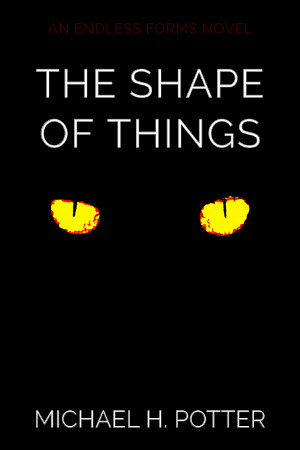
Amazon release: The Shape of Things (Endless Forms 1)

Just a heads-up today, as my latest novel, the paranormal investigation thriller The Shape of Things, is now up on Amazon, in both Kindle and paperback versions. The price is $3.49 for the ebook, $9.50 for the real thing, and here’s the blurb to get you started:

The world is stranger than you know.

Cameron Weir hunts the paranormal. It’s a hobby, a second job, a nice diversion from the rigors of life. Whether it’s ghosts or monsters or aliens, he’ll be there to find the answer. And that answer is never any of those things, because he well knows that monsters don’t exist.

But something is out there. Something lurks in the night. What started as a simple call with a mundane explanation turns out to lead to a much deeper mystery. Glowing eyes in the dark. Strange, animal-like sounds echoing through the night. And then the most monstrous of all: a dead body. In the midst of such weirdness, Cameron questions his own rationality, and that leads him on a trail that will take him to the most fabled monster of all: Bigfoot.

If you’d like to know more, head over to the page for the book, where you’ll find a link to Amazon, as well as my Patreon, where you can get The Shape of Things, as well as DRM-free copies of my other released works, for as little as $1 per month.

Release: The Red Magician (A Bridge Between Worlds 2)

The bridge is still being built, and here is the second step in its construction, “The Red Magician”:

All along, Ayla wanted to do one thing to this world, one thing she never dreamed she could do to the one where she was born. She wanted to make it better, make it into something respectable, rational, modern. She never expected it to be easy, but she always thought she had both the knowledge and the determination to achieve her aims. Now, with the help of her apprentice, Niel, she hopes to carry the light of science across the bridge from her world to this one, as she tries to reinvent a society and herself.

As always, the Otherworld tales are Patreon exclusives, and a pledge of only \$3/month gets you access to “The Red Magician” and a total of 9 other stories in the series. If that’s not enough to convince you to join me on this road, remember that the same money also lets you download DRM-free copies of all my other novels and short stories, including Nocturne, The Linear Cycle, and much more.

Next up is “The Control Variable”, coming May 22. Keep reading, and I’ll see you then!