Solitary shell

I’ve been thinking a lot about mental disorder lately. My own, of course, are at the top of the list.

Seven weeks ago, I embarked on a guided, if self-paced, program of cognitive behavioral therapy. (CBT, but be careful when you’re searching for the acronym!) I’d heard good things about it, that it can, for some people, help treat depression and anxiety about as well as the medication and professional psychiatric help I can’t afford. So I thought I’d give it a shot. I had nothing to lose. If it didn’t work for me, I’d be back where I started, and the only cost would be two months of my life. A fair trade, if I’m honest.

The program is based around a book called Retrain Your Brain. It’s made of seven weekly sessions, each covering one “step” of the therapy. The first step, logically enough, is identification. What’s wrong? Why do you think you need therapy?

For me, that was fairly easy. I suffer from depression and anxiety, and those have only grown stronger as 2020 has progressed. Watching the world burn isn’t as fun as the Joker makes it seem.

The impetus for starting this program came in early August. I’d gone through a few rough weeks. I was sleeping 15 hours a day and still feeling like I couldn’t get enough rest. I was just lifeless, and it affected everyone around me. It strained my relationship with my mom, my brother, the woman I love…everyone most important to me. Worst of all, I felt like giving up. Waking was a chore. Even writing was all but impossible. I hated myself and the world around me, and there were times when I was ready to join people like Kyle Rittenhouse in the fight against tyranny. Sure, it might cost me my life, but maybe I’d be able to make more of a difference in dying than I believed I had in living.

That was when I realized I had to make a change, so I started looking into getting help. Problem is, I’m poor. I’ve been trying to find a steady job for two years without any luck, and a white man isn’t going to get financial help from the state in 2020. Going to a therapist, then, was out of the question. (I’m a little glad. I don’t like the thought of getting on antidepressants.) Fortunately, the internet has resources for the downtrodden.

I took advantage of those resources. I sat down on a Friday evening seven weeks ago and started following directions. Reading, writing, soul-searching. That first week didn’t seem like much, but it was a start. I identified my strengths and weaknesses, I got a diagnosis (moderate depression, but of the atypical sort, as well as generalized anxiety) and a plan of action. In painstaking detail, I explored how my mental problems have affected every part of my life.

A lot of people make light of depression, or simply don’t understand it. “Just be positive,” they’ll say. “Look on the bright side.” It’s not that easy. When you’re depressed, there isn’t a bright side. Everything’s dark and bleak. Combined with my anxiety and a deep, deep fear of failure, that kind of thinking is crippling, because not only were things bad, but I couldn’t even imagine a way to make them better!

The natural progression of the therapy program helped somewhat. After identifying my problems, the next step was to set goals for myself. Nothing much for me; I’m about the humblest man you’ll ever meet. I wanted to lose a few pounds, because who doesn’t? I’m still trying to get a job, still working hard on Rhea, the programming language I’ve been developing for almost a year.

Having the goals in black and white has been beneficial. I’ve made more progress on Rhea in six weeks than I had in the six months before. I started a set of online courses on edX in an attempt at padding my resume, I’m working out (almost) every day, and I even wrote a song. I went looking for a new hobby, something I hadn’t tried before, because you know how much I love learning new things.

Part of this CBT program involved keeping track of my activities. Scheduling them beforehand, then recording on a scale of 1-10 how I felt while I was doing them. I did notice that the early 3s and 4s gave way to 7s and 8s. And that’s honest. I wasn’t padding the numbers like a state health board with coronavirus deaths. I was writing down my true feelings, and they were better.

Retrain Your Brain has a number of case studies, supposedly by the author (he’s a therapist who specializes in this kind of therapy), which it uses as examples of how to do it. So a woman in one study was feeling old and useless because she was out of work and childless at 37. A man had lost his job and was scared he wouldn’t be able to support his family. At times, I felt like I was reading a biography of myself. The similarities were striking, and that got through to me. These are people just like me. They have the same problems I do. And they must have conquered them, or else the author wouldn’t be holding them up as examples. For once in this horrible year, I had a glimmer of hope.

Now, one of the core aspects of CBT is learning to challenge negative thoughts. Depression and anxiety create a lot of those, and I’m no stranger to the dark side of my mind. My “irrational” self, as I’ve come to call it. Training myself to argue against that other self has been hard, but I can say it paid off.

Last Saturday, I was in the middle of a long and winding message to the woman I love (more on that in a moment) when the lights flickered. They then went completely out for a few seconds. “Ugh,” I thought. “I’ll have to turn my computer back on once it’s safe.” I finished the short essay I was writing, which I figured would be enough time for things to settle down, and I booted back up. So far, so good, right?

Lately, I’ve started using the Brave browser for a number of sites that have decided to stop supporting my beloved Waterfox. So Brave came up first, and I loaded up my fediverse refuge, Free Speech Extremist. (See my post from June 7, “Moving On”, for more about that.) As soon as the timeline began to load, the browser froze. No, everything did, except the mouse cursor for some reason kept responding. Even the light on my Caps Lock key didn’t toggle, a sure sign that I was dealing with a hard freeze.

No problem. Handled that before. Let’s reboot and…uh-oh. Now, the freeze came in the middle of booting my KDE desktop. Same symptoms, but now I can’t blame the browser, can I? Well, maybe. Another reboot got me to the desktop, where I started Brave, loaded FSE, and watched my computer grind to a halt yet again. What’s going on here?

“Much wailing and gnashing of teeth,” goes the saying. I didn’t gnash my teeth, but there was literal wailing. Because I was sure that something awful had happened when that power outage occurred. Something got damaged, and now I was dealing with the failure of my one connection to the world at large. I wasn’t scared. I was terrified. This was a full-blown anxiety attack, the likes of which I hadn’t had in almost two years. Everything came together at just the right time to make this perfect storm of fear and stress, and I hated it. I was less than an hour removed from congratulating myself for finishing Week 7 of the therapy, and now this? Where’s the justice?

Okay, Michael. Breathe. Remember the whole point of the therapy. So I challenged the negative thoughts with, as the meme goes, facts and logic. I’m a gifted problem-solver. I can work this out. It’s probably just the video card, because this looks a lot like when I found that shader bug in Star Ruler 2 a few years ago. If I turned off Brave’s hardware acceleration, no freezes. What about Waterfox? No problems there…until I loaded up Shadertoy. A very graphics-intensive site, if you’ve never been there, and it locked my computer up hard. So it has to be the video card.

I resigned myself to finding a new GPU—rather, a slightly older one compatible with my hardware and out-of-date OS. I explained the situation to my mom, since communication is a part of therapy. And then I took a shower. While I was in there, I had an epiphany. What if it wasn’t the card failing? What if it was a bad firmware update instead? When was the last time I did one of those? Back upstairs after the shower, I dug through the system logs and found an update from September 6. That should’ve shown up by now, or so I thought. But Linux, unlike Windows, doesn’t mandate a reboot after system updates, so I never did it. I kept telling myself I’d get around to it.

The power outage did that for me. When I rebooted, it loaded the updated firmware, which was buggy. A downgrade has, as far as I can tell, fixed everything.

The moral of this story isn’t that the latest firmware for an RX 460 on Debian 9 has a serious bug. No, what I’m trying to say is that I was able to work through this problem despite first thinking it was the end of my world. I broke down, but then I followed the steps I’d learned, and the result is that I found a solution. And that really made me feel better. Not that it was possible to feel much worse than I did during the anxiety attack, but I came out of it proud of myself for my diagnostic skills.

One of my goals was to feel more positive about myself and my abilities. I proved that I can do that. If only the rest of them were so easy.

The hardest, even beyond the life-changing goals I’ve set for myself, is also the most important. Depression and anxiety are not my only mental problems. I also have a sleep disorder of some sort, and this has a serious effect on my mental health. Again, the CBT process helped me identify the trouble and work to fix it.

At the beginning of last week, I had shifted into a nighttime schedule. I’d go to bed around 9 in the morning, wake around 6 PM, and stay up through the night. And I felt awful. Back to the lazy, lifeless, irritable thing I’d been. A thing, not a man, because I really did feel less than human. I hid in my room for most of the week, rarely talking to anybody. I also hid from the woman I love; the message I was composing when the power went out was the start of my attempt at…apology? Penance? Contrition? I’m not sure what word works best, but it doesn’t matter yet.

But I digress. The point I’m trying to make is that I identified both my self-defeating behavior and the underlying cause of it. When I’m “off track”, as I’ve come to call it, I suck. I spent last week feeling worthless. Today, by contrast, I got up before 6 AM, and I feel like I could run a hundred miles. Two weeks ago, when I was waking around 9 or 10 in the morning, I was fine. Once I got off track, I went downhill. There’s no other satisfactory explanation.

CBT isn’t supposed to help with sleep disorders. Retrain Your Brain flat-out gives up on that one, regurgitating the tired old anti-insomnia spiel. But it did help me find the problem, and now I can work on tackling it. Another goal I’ve set myself.

Therapy: when it works, it works. This kind has, on the whole, worked for me. It hasn’t solved all my problems. It hasn’t even given me the tools to solve them myself. Despite that, I believe it has been a net positive. Thanks to CBT, I’m better than I was seven weeks ago, and I feel that’s only the start. I know it’s not a quick fix. It’s a process, a path I have to keep walking, but now I can at least find the path. Before, I was just lost. Now, I’m found.

I only hope I didn’t find myself too late.
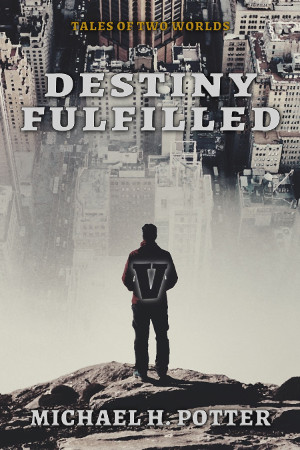
Release: Destiny Fulfilled (Tales of Two Worlds 5)

We’ve come a long way. Some of us more than others. And in the case of two characters from this installment of Tales of Two Worlds, the distance is unimaginable.

For some, the other world is home, and ours is the alien land. A man on a mission discovers that the land he believed a paradise is instead something else entirely. His sister, happy in the life she has made, fears for him, yet she wants him to experience the same wonder she had a year ago. And her husband would gladly forget about the other world altogether, but he knows he can’t. The bonds of family are strong, even when pulled to their limit.

Since it’s an Otherworld story, you know it’s exclusive to my Patreon. And you know it only costs you 3 bucks a month to pick it up. So I don’t need to say that…except that I already did.

Well, no matter. The next in line is also the last. Tune in this November for the Tales finale, “The Price of Freedom”. Until that day comes, keep reading!

Thoughts on: The Lightbringer series, by Brent Weeks

I don’t often do book reviews. There are a lot of reasons for this, but it’s mainly because I feel I get too immersed in a novel. For things like the Summer Reading List Challenge, I’ll do my best. Otherwise, I’d rather talk in more general terms than a single work.

Well, let’s do that, then. Instead of reviewing a book, I’d like to offer some thoughts on an entire series. Specifically, the Lightbringer series, written by Brent Weeks, which I just finished reading.

This fantasy novel series consists of five entries, making it as much of a trilogy as The Hitchhiker’s Guide to the Galaxy. Lately, it seems that five-part series are gaining popularity, as this is the fourth I’ve really delved into in recent years. (The others, if you’re wondering: Peter V. Brett’s Demon Cycle; Django Wexler’s Infernal Battalions; and The Dagger and the Coin, by Daniel Abraham.) I will say that I like this better than the traditional trilogy for genre fiction. It allows more room for expansion, more detail, and an overall slower pace. Some of my favorite things, in terms of reading.

The rundown

As this isn’t a book review, I won’t go into great detail about each individual novel, but it helps to know something about the story.

First off, the list:

  1. The Black Prism
  2. The Blinding Knife
  3. The Blood Mirror
  4. The Broken Eye
  5. The Burning White

Each has its own story, but they are by no means self-contained. Later installments directly continue storylines started earlier, and The Burning White begins with an author’s note that some of its events are concurrent with the conclusion of The Broken Eye. So it’s very much a series, not an anthology.

The overall story revolves around a war between the corrupt, bureaucratic Chromeria and the anarchic White King. In the first novel, those seeds are planted, and they grow throughout the series, coming to a climax in The Burning White. Along the way, we follow a small cadre of characters who play various parts on both sides. Almost all are larger than life, or else they become so. There’s magic, cloak-and-dagger politicking, lots of humor, and an incredible number of battle scenes. Something for everybody, assuming you’re into epic fantasy.

And I would call it epic. Lightbringer features world-changing magical powers, godlike entities, ancient secrets, and anything else you might look for. Weeks builds the tension and the stakes as the series progresses, so it feels natural that the farm boy grows into a hero for the ages. It’s “The One” told in a good way.

Worldbuilding

In my opinion, the absolute best part of this series is its worldbuilding. You know I love that. (If you don’t, just read, oh, anything else I write on here.) As we’re dealing with fantasy, that includes what I consider the most innovative aspect of Lightbringer: its magic system.

The whole thing is based on light and the spectrum, hence the “Chromeria” name above. Magic users in the setting are able to draw on light to activate their powers, which manifest in one of two ways: an effect or a physical substance called luxin. Different colors have different powers, though the people of the setting divide the rainbow into only five colors—indigo and violet are left out. So blue is the highest, and it covers intelligence, rationality, and general left-brained thinking. Not bad for my favorite color.

Going down the line, green is mainly for raw strength, yellow covers a nebulous sort of balance, orange works on fear and similar emotions, and red covers “passions” such as anger and lust. But here’s where the trick comes in. Some of those who can use these powers also have access to other parts of the spectrum. They can literally see into the infrared (“sub-red” in the text, to represent their lower state of advancement or something) or ultraviolet (“super-violet”) parts, even though this is physically impossible for human eyes.

Believable it is not, especially when you get into the rare magic users who have access to the forbidden “colors” of paryl (high-frequency microwaves) and chi (long-wavelength X-rays). Still, it’s fun, and there’s a lot of deep thought behind the lore. Yellow is supposed to be the balance color, for example, but it’s the most unstable when brought into material form, meaning that the spectrum is a source rather than a sink. Tetrachromats exist and are known; they’re the only ones who can properly stabilize yellow, and (this is accurate) they’re almost always women. One of the main characters is red-green colorblind, which comes into play. Infrared magic controls fire and allows one to see heat, naturally enough. Despite the fantastical parts, it’s logical, something I believe is the hallmark of a good magic system.

Downsides are necessary to explain why magic hasn’t taken over the world, and Lightbringer gives a pretty good one. People can only use a finite amount of color magic in a lifetime. They even have a visible manifestation, in the form of “halos” of the color they’ve drawn on that slowly grow to fill their irises. Once they burst through, that’s a sign that the magic has begun to take over the user’s mind. Responsible people go to a willing sacrifice. Those who don’t become “wights”, and are often hunted. And this forms the central conflict of the series.

The Burning White gives a midichlorian-like explanation for the process, but that’s not necessary. What matters is that it all comes together. Using too much magic drives you insane, says the common lore. But what if that’s wrong? What if you could reverse the process? Some people are immune, so it makes perfect sense that these would reach positions of power.


Beyond the magic system, Lightbringer offers a somewhat atypical fantasy world. There’s a mishmash of influences from Europe and the Middle East, with the primary empire called the Seven Satrapies (satrap comes from Persian). Religious and magic-related terms and names tend to be Latin or Greek. Fallen immortals all have names drawn from Near Eastern mythology, such as Abaddon and Belial. One territory is full of Irish influences; another uses Hebrew. Very little fantasy, though.

Technology is another important part of a fantasy setting. Here, Weeks bucks the traditional trend of the High Middle Ages, instead placing his world in a kind of early modern era. Gunpowder weapons are common, from cannons down to pistols. A number of mechanical devices exist. And the technological progress is deftly interwoven with the magic system: lenses, glassmaking, anything to do with light is far beyond the circa 1600 feel of the rest of the world.

Magic and religion also tend to have a curious relationship. With Lightbringer, they’re again combined in a reasonably intelligent manner. The Chromeria represents a monotheistic (and very Catholic) faith, while the enemies are often described as pagans. Cosmic beings lesser than the creator deity exist. Many of them are called “fallen”, mirroring Christian legend. Prophets abound on both sides, and some of them even have a true gift. The sacrificial ceremony for magic users who have gone too far is a sacred one. And so on. Again, smart, and a good use of existing pieces.

The culture, much like the naming, shows a number of influences. Fortunately, modern identity politics doesn’t seem to be one of them. One minor character is a confirmed lesbian (the text uses the term tribadist, another of those little details I like). The protagonist is described as having darker skin, but it seems to be closer to Mediterranean or Arab than African. But that’s about it. Races and sexes mix freely. Merit and magic are the ideals for advancement, although political connections often overshadow them. It’s refreshingly escapist.

The characters

An innovative magic system, a sensible cultural context, a lack of annoying modernity. The setting for Lightbringer comes closer to my preference than anything I’ve read not written by Brandon Sanderson or, well, myself. But setting does not a story make. We need good characters, too.

Well, here’s where things start to get a little hairy. Yes, this series has some great, memorable characters. The protagonist, Kip, begins The Black Prism as…not one of them. He’s an overweight loner who spends his days being bullied by neighbors, his nights abused by his mother. Beaten down, no friends, the object of mockery. Hmm. That sounds awfully familiar.

When I started reading The Black Prism in 2011, I saw a lot of myself in Kip. He quickly became one of my favorite main characters in fantasy, simply because of how real he was. This was the escape I needed: someone like me becoming better. By the time I finished The Burning White nine years later, I have to say that my opinion hasn’t changed. The character did, yet so many of the more mundane changes mirrored my own.

Specifically—and I realize I’m digressing here—Kip gets forced into a political marriage, then comes to love his new bride. She started out in the first book as just another bully he had to face, the stereotypical “mean girl” at school who sabotaged his entrance exam and made fun of him for being fat and awkward. Later, we learn that she has plenty of her own problems. She’s highly intelligent, but people consider her a bit of an airhead because she’s, well, busty. Her sister’s orientation brings her further mockery, and events conspire to bring her low at the same time Kip’s rising.

Kip thinks he’s unworthy of someone so beautiful; I think the same. His wife tells him it’s okay, that they can make things work as long as they have love and trust; my partner says the same. Some of the moments they share in The Burning White rang so true to me that I was almost brought to tears. “I have to help her help me,” Kip thinks at one point, words I needed to read at the perfect moment. “I believe in you,” she tells him at a pivotal point, “but that’s not enough for you, is it? You have to know. For you.” We’ve had that exchange almost word for word. During the final book’s climax, Kip tries to find a way out of a…predicament, and he reflects on all the things he could have done better: “If. If. If.” I wrote those exact same words in a therapy workbook last Friday.

So I’m emotionally invested in the protagonist, far more than in any other series I’ve ever read. But the rest of the main cast is strong. Karris goes beyond the “warrior princess” angle to become not just the strong, independent woman Hollywood wants, but a true leader. Teia has a winding story arc that only ends after a series of epilogues to make Peter Jackson blush; she embodies loyalty and angst and even teenage hormones in a way that leaves her endearing, if a little insane. In later novels, Kip’s soldier bodyguards grow into heroes in their own right, while the head villain of the tale is a proper megalomaniac.

That’s not to say everybody hits the right note. The secondary protagonist is Gavin Guile. The Prism, leader of the Seven Satrapies and the Chromeria, commander of the victorious forces of the civil war a generation before. He’s an interesting man, for sure. His dark side is creepy, but you can see that he tries to hide it as best he can. But Gavin is one of the main problems with the story as a whole, and here is where we enter spoiler territory, as well as my biggest problems with the Lightbringer series. If you don’t want to know the big twists, skip the next section.

The twists

Brent Weeks is a good writer. He’s a master at worldbuilding. He can describe cinematic action scenes in a way I envy. But he can also come up with some of the most ludicrous plot twists I’ve ever seen. The kind of thing even writers of fanfiction would call unbelievable. His other series, the Night Angel trilogy, became legendary for this. I’ve never read it, so I can’t say whether it’s worse than Lightbringer in that regard, but I dearly hope it’s better.

Mostly, the fault I find is that everyone is related, and the relations are downright convoluted. Kip discovers in The Black Prism that he’s Gavin’s son. Except that Gavin isn’t actually Gavin. He replaced his twin brother at the final battle of the civil war they fought twenty years ago. One brother or the other slept with a random woman from the town nearby, and thus Kip was conceived. Except that Gavin’s father claims he actually did that. Meanwhile, Gavin’s other son, Zymun, is a psychopath. Oh, and Karris is his mother. And her brother is the main bad guy.

It only gets worse from there. The real Gavin is alive, we find out in the first fifty pages of The Black Prism. He’s being held in a secret dungeon underneath the Prism’s tower. Except that the fake Gavin goes to kill him one day, only to find he was never there at all…despite a dozen or more chapters from his point of view! The whole thing is a trip, and you can’t blame it all on magic. Some of it has to be the author’s fault.

It’s as though Weeks stopped seeing the forest for the trees. The set-piece reveals are excellent. On their own, I’d eat them up and clamor for a movie version. Too bad they don’t fit into the narrative.

I could say the same for the entire climax sequence of The Burning White. All told, it takes up about a third of the book, almost 300 pages with barely a break to breathe. And it feels like a snowball that turns into an avalanche of insanity. Magic flying everywhere, a conspiracy unmasked, people on all sides looking for whatever advantage they can find. Climax, for both the novel and the series as a whole.

But Gavin’s storyline goes in a different direction. He’s been tasked by assassins with an impossible mission. I’m not making this up. He’s sent to kill God. It makes more sense if you’ve read the books, but not a lot more. Problem is, he’s fully willing to do it. He’s an avowed atheist due to the benevolence paradox, so he wouldn’t even mind succeeding. Then he meets a figment of his imagination in the form of his dead younger brother (this series has a ton of those) who causes him to have a complete change of heart and a renewal of faith. That transformation felt so forced that I almost started rooting for the bad guys. The most skeptical man in the world suddenly becomes the most zealous? The swiftness with which it happened made me think far less of both Gavin and the writer who created him.

So much else happens in that novel-within-a-novel that it’s hard to keep track, and the carefully crafted setting tends to go out the window. Just about every main character ends up going full-on Super Saiyan, none so much as Kip and Gavin. There was always an element of the mythic in the series, but this sequence ramps that up to absurd levels. It left me turning pages frantically, wondering what would happen next, yet dreading how it would be written.

The verdict

That, I think, is an apt description of Lightbringer as a whole. It’s a flawed masterpiece. There is a great story in there. The magic system is top-notch, and the setting as a whole just clicks. I found, after years and years of searching, a character that truly felt like me, who even grew with me. A million and a half words over five books and almost a decade, it’s still what I’d call time well spent.

Yet I’m troubled, because I feel it could be so much more. Some of the red herrings were too predictable. Not all of the twists made sense. A few plot threads were left incomplete. I cringed at the prose more than I have for any other book. The whole thing is ambitious, but that ambition sometimes comes out a mess.

That said, I loved it. Flawed though it is, Lightbringer is epic fantasy, with heavy emphasis on the “epic” part. That seems to be the Brent Weeks style, which is fine. (I tend to write “lower” fantasy, and I do like to read it more, so maybe that bias is coming through in some of my criticism.) Often, I wish a series wouldn’t end. In this case, I’d gladly read ten more books in the setting. Because, no matter our preferences, we could all use an escape from time to time.

Politics and the escape

Seems like we can’t get rid of politics these days. It’s an election year, combined with a manufactured crisis, a race war, and whatever else is going on in the world. No wonder stress-related health problems have skyrocketed in 2020. Not just for me, but for the whole country.

In times of trouble, when the real world is an awful place to be, I normally turn to fantasy or science fiction. Some people have other escapes, but my strongest has always been my imagination, aided where necessary by the words of “genre” fiction authors. The past decade has allowed me to make my mark, and I have consistently stated that I write what I do because I am, at heart, an escapist.

But it’s getting harder and harder to avoid the thorny political problems of the world around me by diving into a novel. That isn’t because I’m having trouble reading. Oh, no. Since being placed under effective house arrest in March, I’ve read more than a dozen different books. Most are nonfiction, history or science books that caught my eye. A couple were fiction, part of my ever-growing “books to read” pile.

I have others in that. I started reading Brent Weeks’ The Burning White this week. Blood of Empire (Brian McClellan) still waits. The Infernal Battalion? Still untouched. And so on.

Why haven’t I been reading as much speculative fiction? If you asked me a while back, I’d say it was because I didn’t have enough time. Or I didn’t feel like committing to it. Those are both lies, of course. I’ve got nothing but time. I have no problem rereading my own novels. I don’t mind checking out an archaeological history of England, a humorous account of mathematical errors, or a study of idioms originating in the King James Bible.

No, my present problem with fantasy and sci-fi boils down to politics. As part of my treatment for depression and anxiety, I’ve been tasked with a series of introspective exercises, and those have helped me come to terms with this.

In a nutshell

It isn’t politics per se that turned me off fantasy. I don’t mind a novel with political wrangling, as long as there’s a good story in there. But I feel like I’ve read all of those. Martin has basically stopped writing. So has Scott Lynch. Jim Butcher needed six years to come up with a new Dresden Files entry, and the reviews I’ve seen of Peace Talks say it’s incomplete at best.

I’m not even opposed to political allegory, if done properly. I mean, I’d be a hypocrite if I said otherwise. My Nocturne, written in November-December 2016, was unabashedly political. (Funny how its themes are still relevant now.) I don’t mind exploring an important topic through the metaphorical lens of fiction.

But there are good and bad ways to go about it. Lately, I see too many authors—prominent, professional authors who really should know better—taking the bad route. It’s one thing to write a character, even a central character, to hold a firm opinion on an issue. I’ve done it often. In my Otherworld series, Ashley starts out as a stereotypical feminist, while Damonte is openly socialist. Martevis, a protagonist of my Hidden Hills novels, might have common friends, but he retains an aristocratic view of social class. The Modern Minds short stories feature a character whose mother is a very…zealous evangelical.

Too often, the pros I once idolized have made the decision not to write characters like those. Instead, they preach. It’s not enough for the characters to believe in a cause. No, the narrator has to believe in it, too, even when that narrator has no connection to them. And the cause has to be front and center at every possible opportunity, whether or not it contributes to the progression of the story.

Most of the examples I see in fiction today are of the leftist bent. As I’ve stated in prior posts, I’m, well, not. “Classical liberal” is the closest label I’ve found to describe my leanings, and it’s far from perfect. But I’m not complaining because I disagree with the politics. I’d say the same thing if the narrative preaching were progressive, conservative, libertarian, authoritarian, anarchist, or any other form you could imagine. (Seriously. Ask me about Ayn Rand sometime.)

No, it’s not that I don’t like what you’re saying. It’s that I can’t stand how you’re saying it. Berating the reader is never a good recipe for success. Beating me over the head with political theory in what was supposed to be a fun, relaxing escape from reality takes away any joy I might have gained.

Illustration 1: The Expanse

It wouldn’t be a PPC post without some illustrative examples, so here’s what I’m ranting about this time. First, The Expanse, by James S. A. Corey. I enjoyed the opening book, Leviathan Wakes. It got me back into space-based sci-fi after a decade away. And the series continued to impress. Cibola Burn had some major plot holes, Babylon’s Ashes was forgettable, but the whole thing was just so fun and refreshing.

In the seventh book, Persepolis Rising, I became thoroughly disillusioned. It was around that point that I noticed there were no stable, monogamous, heterosexual relationships anywhere, except for the villains. Holden and Naomi are content to FWBs. Alex is coming off one failed marriage when the series starts; he adds a second in the 30-year jump between books 6 and 7. Amos is a psychopath who avoids commitment. Holden’s “parents” are a group of seven people who did some genetic trickery to have a baby sharing DNA with all of them—mostly for tax purposes, not because they wanted to perpetuate their lineages.

Yet there are plenty of…alternative arrangements that take center stage. In Abaddon’s Gate, we see a lesbian couple whose names I can’t remember. Babylon’s Ashes has Pa and her polyamorous crew. The only “traditional” family that gets more than a brief mention is that of Duarte, in Persepolis Rising. The megalomaniacal Martian who (spoiler alert!) ends up conquering the entire solar system with the help of alien technology is just about the only man with any serious screen time who has a wife and a child. Earth’s population had somehow reached fifteen billion by the starting point of this series, and I’m left wondering how.

The Expanse’s political browbeating doesn’t stop there, alas. Early books were fairly neutral. Earth has its share of good and bad. Belters very naturally develop a terrorist wing due to their constant persecution. As the series progresses, however, it takes a hard left turn. Corporations are ubiquitous in the setting, but they are rarely, if ever, shown in a positive light. The idea of “consent of the governed” is widely viewed as fringe, if not crazy.

The killing blows, in my opinion, are twofold. Persepolis Rising introduces the new bad guys, and I couldn’t help but imagine the authors (James S. A. Corey is a shared pseudonym) saying, “Why don’t you understand that we’re talking about Trump?” It’s okay to base a foe off an important historical figure, but this is much too transparent. Adding insult to injury is the way essentially every male character has been marginalized or emasculated. In the future, apparently, boys aren’t allowed to have heroes.

Illustration 2: Demon Cycle

Peter V. Brett’s Demon Cycle series is another one I liked to start. The Warded Man was a great book, and I’ve sung its praises on this site before. Brett has a great worldbuilding mind. He can handle dialect, something few others bother to try. And he made a great antihero in Arlen Bales.

It’s everything else that’s the problem. The enemies of the setting are the Krasians, who are best described as Muslim ninjas crossed with the Bene Gesserit from Dune. Arlen’s first meeting with them is as a trader who joins their fight against the nocturnal demons who haunt the world. He leaves in disgrace, beaten and raped, and this seems to be a common theme in the series. Okay, that happened in history. Not so bad, right?

But it goes downhill from there, in my opinion. The patriarchal, indeed misogynistic (and I, unlike your average Twitter user, do not use that term lightly), Krasians are secretly controlled by their women. Their emperor’s wife uses blood magic to control his mind—when sex doesn’t work, anyway. His daughter secretly creates a women-only assassin squad. The whole thing is more full of holes than the official coronavirus narrative.

It takes away from what was otherwise a decent, innovative fantasy series. The whole message at every turn seems to be “White men can’t do anything right unless they’re helped.” Arlen was a prodigy, but he’s about the only one. Rojer comes across as somewhat bumbling, and ends being manipulated by women. Jeph, Arlen’s father, is just plain pathetic. Every other white male character is an oaf, an opportunist, or a cuckold. Meanwhile, the women of the setting rule everything, whether behind the scenes or out in the open.

Go broke

If that phenomenon were limited to a single series in fantasy or sci-fi, I wouldn’t have much to say. I’d just not read those books. But this is pervasive, and it all goes in only one direction now. It’s the same problem Hollywood has. It’s the same problem video games have. Story so often takes a back seat to diversity, yet diversity of thought is never allowed. The good guys must never be just guys, for instance, because that’s sexist. Capitalism always results in dystopia. Religion is only ever tyrannical, unless it’s tribal shamanism, in which case it’s the most powerful force in the world.

But that’s not an escape. If I wanted to read about the black transgender heroine facing off against the evil colonial corporation that’s all-white, I’d just go on Tumblr, or Reddit, or Twitter, or Mastodon, or…you get the idea.

Fantasy worlds aren’t ours. They don’t have our problems; they have their own instead. I’ve written scores of articles about this very thing, but it’s only getting worse. The political cancer has spread into my last refuge. Is it any wonder I’m depressed, or that I’ve switched to reading history and science books?

I don’t care what you believe. If you want to think that communism is great, fine by me. I vehemently disagree, but that’s your right. Think that America should expel anyone who isn’t a white Christian? I’ll oppose you with all I’ve got, but I won’t stop you from expressing your opinion. Until your ideology infringes on my rights, it’s none of my business.

That said, is there any reason to force it into your writing? The answer, of course, is a resounding no. Nothing should be forced. That’s just poor writing. You may pat yourself on the back for making your characters so “woke” that you get all the internet points, but it doesn’t make them deeper. Cardboard cutouts are boring no matter where they fall on the Political Compass.

No, if you can’t be subtle about it, leave the real-world politics in the real world. I didn’t come to your book for a lecture on how awful the conservatives/progressives/whatever are. I came to get away from that.

Summer Reading List 2020: Finale

The past few weeks have been utterly miserable for me. What reading I’ve done has mostly come while I was eating, because that’s the only time I can keep my mind focused on something other than how awful I feel. That I managed to finish two more books despite the depression, the anxiety, and now the dissociation boggles my mind.

But enough about that. Let’s see the other two entries in the Summer Reading List Challenge for the worst year ever.

History (non-fiction)

Title: Northumbria: The Lost Kingdom Author: Paul Gething and Edoardo Albert Genre: History/archaeology Year: 2012

I’m an archaeology nut. Ever since I started writing my Otherworld series, I’ve found a passion for studying ages past. More recently, I became enamored with the series The Last Kingdom, first by reading the Bernard Cornwell book of the same name, then watching the show. It’s gritty, it’s fun, it’s epic, and I love the setting for multiple reasons.

Well, the protagonist of The Last Kingdom, Uhtred, hails from the English town now known as Bamburgh. Long ago (before the ninth century, when the series is set), Bamburgh, with its imposing castle overlooking the North Sea, stood as the seat of a kingdom: Northumbria. And the castle has offered up a wealth of archaeological findings that help us better understand life in Anglo-Saxon times. How the people there lived, what they ate, what they wore.

Gething and Albert explore the strange world of ancient Northumbria in this book. They call it a “lost” kingdom for many reasons. It’s obviously just one corner of England now. It was the first Saxon kingdom to fall to the Viking incursions. And we simply don’t know much about it. But now I know a lot more than I did, and I find myself even more interested in that long-gone world than before.

To be fair, there are problems with the book. At times, the authors come across as overly preachy. They do the usual politically correct dismissal of the term “Dark Ages”, which is entirely appropriate for a period of centuries with social and technological stagnation, if not regression. They’re always quick to go on about ethical concerns. On the whole, though, it’s not too obtrusive. The faults are minor, and they don’t distract from a lively, humorous, and above all informative journey through Anglo-Saxon times.

Suspense (fiction)

Title: Verity Author: Colleen Hoover Genre: Suspense/mystery Year: 2018

Rules are rules, and one of my self-imposed rules was to read something from a genre I don’t normally read or write. Fortunately, my partner had talked enthusiastically about a novel she read some months back. She’s big into mysteries and thrillers, neither of which normally tickle my fancy, so I thought right then and there that her suggestion would make the perfect addition to the Summer Reading List.

Verity was a short novel, but a hard read for me. Partly, that’s from parts hitting too close to home. The protagonist, Lowen, is an author. She’s had a lot of family troubles lately. She lacks self-esteem and pride in her work. She suffers from anxiety. The parallels are obvious, but they end pretty soon. Lowen actually has things I don’t: a publisher, an agent, a portfolio that gets her a job ghostwriting for the preeminent author in her genre, Verity Crawford, who has suffered a major accident that leaves her unable to continue writing. Thus begins the mystery, because something is up with the whole situation.

Without going too far into spoiler territory (it’s a mystery, people!), I’ll say that I was somewhat hooked. The way the story is told left me jarred, as it cuts between the first-person perspectives of Lowen and—through an autobiography manuscript Lowen finds—Verity herself. Even I couldn’t pull that off in Nocturne. Credit where credit is due, because Hoover managed it. The autobiography parts left me feeling unclean from the sheer depravity that sometimes came out, while the “main” narrative eventually veered into some quite explicit romance that made this red-blooded American male a bit uncomfortable.

I’m constantly comparing myself to “professional” authors of fiction. I can’t help it. Lately, in my preferred genres of fantasy and science fiction, I’ve judged my own efforts equal to, if not better than, the pros more and more often. As I’ve never written suspense or mystery stories, I’ll withhold judgment here, apart from a couple of nitpicks. Hoover’s prose is occasionally…off, in some way I find hard to explain. She repeats herself too often for my tastes, and I almost wonder if that was padding a word count for what was already a fairly short novel. The final twist also left a bad taste in my mouth. It doesn’t come completely out of nowhere, but it was definitely a blindside hit. In all honesty, I feel it’s the weakest part of what was otherwise a great, if unconventional, novel.

Conclusion

Another summer is in the books, but I’m not done. Later this week—assuming nothing else goes wrong—I want to look at a couple of my aborted attempts at the challenge. There’s a very good reason, one I’m not going to tell you just yet. Always leave them hanging, you know?

I hope you enjoyed the last three months more than I did. If you participated in the challenge, I can only thank you from the bottom of my heart. Win or lose, you’ve done a great job. If you’re just here to read about me, then I have two things to say. One, you probably need your head examined more than I do. And two, I did have fun with these books. Maybe they aren’t perfect, and they might not be to my exact tastes, but they were worth my time. I’d like to think I’m worth yours.

Thank you again, and remember to keep reading!

Thanks to all

To Samuel, Mary, Luis, Karl, Henri, Ali Abdullah, Renee, Enrique, Brother Bernhard, and Father Alonso: Thank you for starting me on this journey. You were my first, and I will never forget you.

To Jay, Jane, Max, Agosto, Sienna, and Vance: Thank you for letting me dream. I needed it so badly at the time, and your nightmares led to my peace.

To Dusk, Captain Varens, Hella, Porter, Princess Leliya, and Tod: Thank you for providing catharsis and vision. Because of you, I learned more about myself.

To Shade, Kellis, and Artoran: Thank you for being my best. You’re still on my mind, and the world still needs you.

To Asho, Chei, Gallan, Martevis, Jarra, Taniss, Issa, Madon, Leli, Kagen, Deena, and Yanna: Thank you for the wide expanse. You let me explore my favorite theories.

To Rick and Drew, Thomas and Mira: Thank you for being in the right place at the right time. Yours may not be my most notable works, but I still remember and cherish them.

To Levi, Justin, Gabriel, Nic, Hanna, Mika, Lucas, Ed, Malik, Reza, Tori, Derry, and Alicia: Thank you for the sheer fun you bring. I can’t not smile when I think of you.

To Jessie, Dirk, Tabitha, and Isaac: Thank you for the window to the past. I know my grandparents would have loved to meet you in your own time.

To the other Lucas: Thank you for showing a side of me I didn’t know I had. I’ve found my own angel to love; I hope the rest of your tale can come true for me, too.

To Cam, Cassie, Lana, Anthony, Charlotte, Angie, and Britney: Thank you for fighting back the darkness. I fear the monsters in the real world aren’t so easy to tame.

To Ian, Steph, Blake, and Trish: Thank you for playing this game. You almost killed me the first time, but I’ll get back to you soon, I promise.

To Benit, Lia, Coss, Raneph, and Ketah: Thank you for showing both sides of a conflict. Yours is too gritty for me right now, so hold on a little while longer.

To Alex, Amy, Ryan, Jenn, Jeff, Ashley, Lee, Sara, Ayla, Ramon, and Damonte: Thank you for the world you opened. It’s been a great escape.

To Nimiesa, Irai, Niel, Egas, Desva, Cambi, Asirii, Nisha, Jeidis, Donyalei, Chaerys, Etanya, Direlmas, Nateya, and Chahin: Thank you for letting me into that world. I wouldn’t mind living in it…as long as you don’t worship me.

To William, Tyler, Emily, Jeanette, Joel, Phenom, Taos, Donny, Cristina, Zach, Damian, Kyle, and Jordyn: Thank you for carrying the torch. You brought fresh blood to my magnum opus.


Wow. I thought I was over a hundred total narrated characters, but I wasn’t sure of the final tally until this. The magic number is 114, apparently. A hundred and fourteen different points of view. That many other voices in my head. Nothing special about the number at all. I just wanted to know. Call it a census, because that’s a thing this year.

I consider all my characters to be something like my children. Now that I see just how many I have, I’m…proud. And I really do thank them. By speaking through them, I’ve been able to say things I would otherwise keep to myself. By looking through their eyes, I’ve seen many strange and wonderful sights.

For those wondering, here are the specifics. I only included characters whose perspectives I have written, whether in the first or third person. The list is grouped by story or series, for the most part. The Otherworld group takes up three slots: the first season’s expedition team, the natives, and everyone else. They’re just too big to treat together. Except for them, it’s mostly chronological order, but that’s not perfect—I can’t remember exactly when I wrote some of these!

I haven’t published Heirs of Divinity, Shadows Before the Sun, or “Satellites” in any fashion, and “Miracles” has been rescinded until I can edit it. The fourth Orphans of the Stars novel, Time in the Sun, is unfinished, but the points of view are set, so I counted it. I did not count Blue Mesa, as I have no plans to go back to it; it’s ten years old at this point, and it was frankly awful to begin with.

I did have to double-check the epilogue characters from Heirs of Divinity (the last four in the first group). Everyone else was from memory except Ketah. 109 out of 114 is a pretty good score, I think.

So much has happened since I sat down on a warm November afternoon and started typing out a scene of a seventeen-year-old young man from 18th-century York running for his life after a failed gunpowder bombing. My life has taken some turns. I don’t know if I’ll still be writing in 2030, but if I am, I’d like to come back to this post. How many new names would I be able to add to the list?

Otherworld and reality

For the most part, I try to make my stories natural. They aren’t necessarily believable, as many of them are set in fantasy worlds, but I strive for realism of the sort that can make a reader feel drawn into the world. So characters act like people. Dialogue is sometimes halting or rambling, depending on the situation. And the settings get a lot of love from me, because I just enjoy worldbuilding.

Otherworld, the setting of my largest series (31 parts and counting!), is no exception. Really, it’s the poster child for my “hardcore” style of worldbuilding, as I’ve stated on numerous occasions. I started developing the world in 2013 as little more than a conlang playground, then redesigned it in 2015 as part of my serious writing push. Through it all, I’ve tried to keep one goal in mind.

This could be our world.

Sometimes, that doesn’t work out. Nobody could have predicted the coronavirus panic this year, that the entire world would shut down for months. So Otherworld stories don’t talk about that; for them (and my other “Paraverse” novels, such as the Endless Forms series), it was nothing more than another swine flu scare. Likewise, the characters don’t have to worry about riots when they’re on Earth. Even the original deus ex machina for getting them away from our planet didn’t materialize: Tropical Storm Chantal was late last year, and it didn’t go where I predicted it would seven years ago.

Despite those flaws, I try to keep Otherworld as close to reality as possible while maintaining the dramatic aspects of the stories. It fits “in the gaps”, so to speak. We don’t know that these things don’t exist. Absence of evidence is not evidence of absence.

The big one

Of course, keeping that fiction alive is hard to do when you look at the overarching hypothesis of the series. To sum it up, the Americas were inhabited long ago, far longer than our theories (as of 2013) suggest. The original inhabitants were advanced, and possibly not even fully human—the truth of that remains a mystery even to me. They didn’t have an empire, but they did create numerous points of civilization that have since been lost.

This culture was far better adapted to the cold, dry climate of the Ice Age. When it ended about 12,000 years ago, their largest settlements sank beneath the rising seas, which is the main reason we can’t find them. (Yes, it’s an Atlantis riff. Sue me.) Seeing this catastrophe, they evacuated, using a set of ten mysterious sites containing wormholes. These linked to corresponding sites on another Earthlike planet, a colder one in general, where they set up shop.

Along the way, they brought the plants and animals they were familiar with. Some of those we know: Otherworld has corn and potatoes, New World raccoons and squirrels, though nothing not native to the Americas, with the possible exception of bottle gourds, which may have come over during the Ice Age. But it, unlike Earth, did not suffer the Pleistocene extinctions. So there are mammoths, sabretooth cats, dire wolves, and a few others.

This ancient civilization also interacted with the “first” Americans. Indeed, they traded with them, taught them, respected them. When their perceived apocalypse arrived, they took some of their neighbors with them to their new home. Thus, Otherworld’s natives are cousins to America’s natives. They aren’t the Aztec, Maya, Inuit, or Iroquois. They’re their own people. But they’re related, and they’re much closer to these than they are Europeans, Africans, or Asians.

Once they crossed over, the two races mostly returned to their dynamic. The ancients continued to learn and teach, even going as far as genetically engineering new sub-races of humans. The less-advanced natives accepted their wisdom, in some cases deifying them.

That worked until Otherworld began to snap out of its Ice Age about 4500 years ago. The ancients, now with nowhere else to go, retreated to high mountains and the Arctic counterpart, pushed along by one of their created races. (One small part of this tale is told in my free novel Seasons Change.) Whether any of them remain is an open question, one I have yet to see a need to answer.

Keeping it real

So that’s the backstory. Almost none of it really matters to the main plot of the stories, except that the characters from Earth are trying to piece it together out of curiosity. Still, I wanted it to be something that sounded plausible and wouldn’t be debunked easily. Yes, I’m aware that we’d probably have found evidence of advanced technology before now. And there’s not a millennia-old temple hidden around Soto la Marina, Mexico. Or Pine Bluff, Arkansas; Fossil, Oregon; Pelican Narrows, Saskatchewan…

Still, there could be. So what about the rest of it? Specifically, the timeline. How does that hold up after nearly a decade of new research?

Pretty well, in my opinion. The “gap” trick continues to work, keeping my ancients safely away from debunking. Even better are some of the findings that have come to light in the past three years.

We used to know the timing of the first Americans. It was a done deal. Call it about 13,000-15,000 years ago. They walked across a land bridge where the Bering Strait is now, then kept going through a narrow corridor between the glaciers in western Canada, following the plentiful game as they rapidly spread out through the two continents. Within a thousand years, they were everywhere from Alaska to Argentina, known by the distinct stone artifacts first found in Clovis, New Mexico.

By 2013, that theory was already beginning to crack. Now, it’s dead in the water. Spear points predating the Clovis style have been found in a number of locations, most notably Gault, not too far north of Austin, Texas. Bone tools in the Yukon site of Bluefish Caves go back a full ten thousand years before the earliest Clovis theories—they’re twice as old as the end of the Ice Age!

I’ve incorporated some of these into the Otherworld series. The remains of a child in Alaska showed DNA markers distinct from any extent Native American populations; she became, in my telling, a possible member of the ancient civilization. A similar find in Mexico dates to the “evacuation” period of my setting, and I’m on the fence as to whether that one represents an ancient or one of their neighbors who stayed (or was left) behind at the end of days.

So far, there’s nothing that really destroys the worldbuilding. In fact, some of the archaeological finds can actually be seen as strengthening it. None of them do so as much as last week’s.

Bombshell

The paper is “Evidence of human occupation in Mexico around the Last Glacial Maximum” by Ardelean et al. Written in 2018, it was published in the online edition of Nature on July 22. Six days ago. You don’t need much searching to find a copy…if you know where to look. (I’m not supposed to link to such sites, of course.)

Chiquihuite Cave is in the Mexican state of Zacatecas. Right in the middle of cartel country, I’ve read, so you can imagine how hard it is to run a dig there. Inside were found nearly two thousand stone artifacts: cores, flakes, blades, points, you name it. A bit of charcoal made from a Douglas fir, found near one of the points, provided an estimated date, and it’s unbelievable if you’re a “Clovis-first” adherent.

28,000 years ago. No joke. Twenty-eight thousand. In other words, about as old as the Bluefish Caves bone, which not only guts the theory that the Clovis points represent the oldest inhabitants of the Americas, but also drives a big nail into the coffin of the “Beringia standstill” hypothesis. That states that the first Americans came over from Siberia during the Ice Age, then settled down in Alaska and northwest Canada for a few millennia, sometimes ranging down the Pacific coast in boats.

Of course, the odds are astronomical that these are the oldest human tools south of Juneau. More likely, they represent a snapshot of a culture that lasted for hundreds or thousands of years, which only pushes the migration date further back in time. So we’re really looking at 30,000 years or more.

The population probably wasn’t very high, and these are nomadic hunter-gatherers we’re talking about. Not the ancients of Otherworld at all, yet Chiquihuite is evidence that people were living in the Americas—all throughout North America, for certain—not only at the end of the Ice Age, but at its height. The climate would have been much harsher then. Cold and dry in general, with a lot of erratic patterns near the glaciers. Sea levels were a hundred or more meters lower than today, so as much as three to five hundred feet, which pushes the coastline many miles out from what we see in the present. In other words, plenty of room to hide an Atlantis.

And that’s what I take away from the Ardelean paper. Beyond the groundbreaking discovery itself, I’m happy to see that my outlandish worldbuilding of seven years ago still survives to this day. With upheaval all around it, my creation stands. It grows. I already consider Otherworld to be my greatest creation. Now, though, I can take even more pride in what I made, because it’s…prescient, in a way.

I hope future discoveries can further enrich our knowledge of the earliest Americans. I don’t hold out hope that we’ll find wormholes and genetics experiments, as that’s too crazy even for me. But any evidence that the indigenous peoples of this continent were growing along similar lines to their brethren across the ocean is welcome. Add in the intriguing possibility that the Chiquihuite culture isn’t related to any known Native Americans, and then you start to wonder what else is waiting to be found. Who were the first people to settle in what’s now the US, Mexico, Central and South America? What kind of world did they inhabit?

Were they more than we believe?

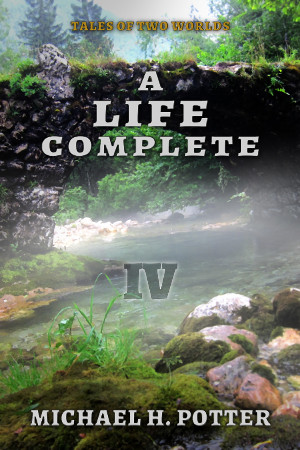
Release: A Life Complete (Tales of Two Worlds 4)

Four down, two to go. The Tales of Two Worlds series enters its second half with this fourth installment, “A Life Complete”, which returns to two of my favorite characters in the entire setting. I hope you enjoy them as much as I do.

To live in the other world is to cast away much of what makes a modern man…or woman. Amy knew this, and she willingly gave up the life she knew, its comfortable familiarity, for love of the unknown. Alex, by contrast, chose this path because he felt he had nothing to lose. Both see now that the road is hard, the struggle real, but they believe that, by working together, they can overcome the obstacles while bringing into their new lives a little piece of the old.

If you want to check this one out, you can find it and all its many brethren over at my Patreon. A mere 3 dollars per month is all it takes, and you get more than just a few novellas. So much more.

For those of you following along at home, the pattern should be obvious. We’ll come to the penultimate tale in September, and it’s called “Destiny Fulfilled”. I can’t wait, but you can keep reading!

Summer Reading List Challenge 2020: Number one

I actually finished reading this book a couple of weeks ago, but I’ve been so caught up in other things that I forgot to post my thoughts on it. And since I’m persona non grata at my old fediverse haunt, this is probably the only place you’ll see 2020’s entries in the Summer Reading List Challenge.

Science (non-fiction)

Title: Humble Pi: A Comedy of Maths Errors
Author: Matt Parker
Genre: Popular science
Year: 2019

The author is an Australian living in Britain, so you’ll have to forgive the misspelling in the title. Never fear, however. The rest of the book more than makes up for it. Humble Pi is a fun little look at some of history’s oddest, funniest, or occasionally deadliest math fails. The Gimli Glider, a jet airliner forced to land on an airstrip definitely not built for it, all because someone read the intended fuel load in pounds instead of kilograms. NASA’s Mars Climate Orbiter, which crashed into the Red Planet because of a similar units mix-up. The Tacoma Narrows Bridge, the “flash crash” of 2010, overflow bugs, and secret islands, all these and more are covered in an irreverent, yet knowledgable, style.

I consider myself a recreational mathematician. I’ve read books about numbers and math since I could read, so going on 35 years now. I love this kind of thing. And I’ll admit that I already knew of most of the stories in Humble Pi, but not always the details. Parker does a good job of explaining those to the lay reader, while keeping the interest of someone who doesn’t need hand-holding. He’s deliberately vague in a few cases, which irks me. Fortunately, those don’t distract, and he makes up for it with good descriptions of things non-experts wouldn’t even care to learn. SQL injection attacks, for instance. Or statistics as a whole.

All in all, unless you’re deathly allergic to numbers, you’ll be entertained. Why? Because you get to see that, no matter how much everyone wishes it would, math just doesn’t go away. And people make mathematical mistakes the same as in any other field. Which is great for readers, as who doesn’t like to laugh at a billion-dollar corporation or government agency failing at something we’re taught in elementary school?

Full stack adventures 1: Meet the stack

I have a lot of different development projects. Most aren’t all that great, and some of the older ones are…well, they’re awful. (For the morbidly curious, I have many of them on GitHub, and my newer ones will start to appear on Gitlab.)

My current one, however, has been an adventure. It’s useful, it makes for a good learning experience, and it has a very wide range of technologies. I’m truly working with a full stack on this one, even if I may not be playing with a full deck.

What it is

The project is called Pixeme, a portmanteau of “picture” and “lexeme” that, in my opinion, captures the essence of what I’m trying to create. Basically, I took the old saying “A picture is worth a thousand words” far too literally.

My goal is to make a full web platform for what I describe in the documentation as a community for visual language learning. To put it simply: users post pictures with simple, descriptive captions. Nothing more than a single word or phrase, though they can add more text later. What separates this from, say, Instagram is that other users (or the same one) can add captions for other languages.

For example, I could post a photo of my stepdad’s dog with the caption “a dog”. Then, someone who speaks French might come along and add “un chien” to it. A Japanese user could then add “犬” to the mix, and so on. Together, we build a kind of cross-language picture dictionary. This can then be used by people who really are trying to learn languages and understand that visual reinforcement helps.

(I have plenty of other ideas, things like audio attachments, larger texts, Anki-style flashcards, adding in support for constructed or artificial languages, and even possible research uses, but those are all for much later. Let me get the site started first.)

All in all, Pixeme checks all the boxes for me. It involves programming and linguistics, two topics which any reader of this blog will know are among my favorites. It’s a long-term project, so it requires focus but gives the satisfaction of completion in return. And maybe I can even find some way to monetize it in the future. Even if I can’t, it’s still valuable experience with a number of different languages, frameworks, and libraries.

The stack

Every web application is layered. There’s no way around it. At the very least, you have the server side and the client side, but most modern apps add in multiple extra layers, forming a stack. Pixeme is no exception. For this project, I chose a stack which, for the most part, reflects my personal preferences while also allowing me to stay on top of current developments in both sides of the web equation.

The server-side framework I chose is Flask. I like Python. Even though I feel the 3.x series was a needless break in compatibility, it’s still one of the few languages I feel comfortable writing. I’ve joked before that I can write Python in my sleep—that’s how much experience I have, and how much it fits my mindset.

Flask calls itself a “micro-framework” for web applications, meaning that it comes with very few bells and whistles, but plenty of extensibility. And I like that, too. It’s a little harder to set up, as you have to track down a number of extensions for things like database connectivity, form validation, authentication, etc., but that’s okay. You only pay for what you use, and there’s nothing hidden.

Apart from Flask extensions, the rest of the back end is pretty standard. SQLAlchemy and PostgreSQL, which is pretty much Python Databases 101. Pytest for testing, because tests are important. (I’ll admit that I haven’t always kept those up to date in past projects!) The Marshmallow library for serialization and validation. And the usual host of minor packages for little things. You can’t get away from those.

The front end is where things get interesting. Pixeme has a REST API because that’s the cool thing to do these days, but also because it really does make things easier even when you don’t want an SPA. And I decided after writing half of one that I don’t want another SPA. It just doesn’t fit the vision I have for this platform. Oh, there will be an app eventually, and that’ll have web and mobile versions, but the site itself needs to be the initial focus.

Flask includes the Jinja template engine; you can use your own, but it’s easier to go with the default. So I’m writing the view layer (Pixeme mostly follows the typical MVC architecture, in case you were wondering) as HTML templates using Jinja. That’s sometimes harder than it looks, one reason why this post is the first in a series. We’ll get into some of the difficulties later, though.

HTML isn’t the only part of the web in 2020, so Pixeme has a whole client-side layer, and this is where my focus on minimalism ramps up. As I said, I gave up on an SPA for the initial version of the site. I personally like Vue over React, so that’s where I started. But then I saw how I was duplicating so much of the server functionality, so I decided to back up and make a more traditional site. Still, reactivity is great, so I turned to Alpine.js to fill that niche. It’s not perfect, but it’s very helpful, and I’ll explain that later in the series, too.

Last, CSS. I know what you’re thinking: Bootstrap. Or maybe Bulma or one of the other alternatives. And those are great. I’ve used them before, and I do enjoy them…when they fit. I wanted to try something different with Pixeme, something more customized, so I chose TailwindCSS instead. It takes more setting up, it doesn’t play perfectly well with Jinja (yet another topic for another post), but it suits me. Once I grasped the concepts behind it, it just made so much sense.

So that’s the Pixeme stack. Python, Flask, and Postgres are the server side; what OS the whole thing will run on is still an open question, but bet on some flavor of Linux. Jinja for templating and views. A front end built with Alpine and Tailwind. “Full stack” is always a juggling act, and this might be my most ambitious attempt yet. Stay tuned to see how it works out.

css.php