
Summer reading list 2022
Hard as it is to believe, it’s Memorial Day again, and that means summer has unofficially started. Not only that, but the holiday marks the beginning of what has become an annual tradition for me: the Summer Reading List challenge. For the 7th year in a row, I hope to complete it, and I’d love to see anyone else join in. (This year, I didn’t forget until halfway through, so it should be a little easier!)
The rules haven’t changed. Really, they aren’t rules, but more like guidelines. This isn’t a competition. It’s a challenge. What’s important is that you’re honest with yourself.
-
The goal is to read 3 new books between Memorial Day (May 30) and Labor Day (September 5) in the US, the traditional “unofficial” bounds of summer. (For those of you in the Southern Hemisphere reading this, it’s a winter reading list. If you’re in the tropics…I don’t know what to tell you.)
-
A book is anything non-periodical, so no comics, graphic novels, or manga. Anything else works. If you’re not sure, just use common sense. Audiobooks are acceptable, but only if they’re books, not something like a podcast.
-
One of the books should be of a genre you don’t normally read. For example, I’m big on fantasy and sci-fi, so I might read a romance, or a thriller, or something like that. Nonfiction, by the way, also works as a “new” genre, unless you do read it all the time.
-
You can’t count books you wrote, because they obviously wouldn’t be new to you. (Yes, this rule exists solely to keep me from just rereading my books.)
As always, I’ll search for something new (at least to me!) and share it with you when I’ve finished reading it. I’ll post it over on the fediverse (@mikey@freespeechextremist.com is my main account there for the time being) and in more depth here at PPC, but feel free to discuss your own reading adventures wherever you like.
Have fun, and keep reading!
From Russia with love
The war between Russia and the Ukraine has been raging for about three months now, and everything I’ve seen so far only proves that my initial suspicions were on target. While mainstream Western media is quick to cast this war as the heroic underdog fighting for its very survival against overwhelming odds, the truth is far different. If you look at unbiased (or at least not as overtly biased so far in favor of the Zelensky regime) sources, you can see that truth. Russia is winning, and that’s ultimately a good thing for all of us.
Okay, I know that sounds strange, but think about it for a minute. First of all, the Russian army is showing everyone how to wage a modern war without overwhelming firepower. They’re doing something completely different from the usual American plan of Shock and Awe, of leveling entire cities to rubble, then hoping the survivors would welcome them as liberators. Instead, Russia is playing the long game, adapting old-school siege tactics and encirclement strategies to the 21st century as they force their foe to expend valuable materiel and manpower.
Better yet, now that the Ukrainians are almost completely out of domestic equipment, they are increasingly reliant on NATO and the billions upon billions of dollars we Americans have been forced to pay to prop up this dying regime. This proves beyond a shadow of a doubt that “our side” had no intention of playing fair. It exposes the rot at the top of Western governments by showing that they care more about the haven for their money laundering and sex trafficking than they do for their own people. With trust in the media and so-called “experts” cratering all across the US (well, with the exception of socialist utopias like California and New York, where you’re expected to wear two masks while you’re paying $7 for a gallon of gas), Putin’s move comes at the perfect time. Every American who turns of the propaganda machines and algorithms is quickly seeing the truth of the matter. One would hope they’ll start to do that for everything else, too.
At every point in this war, Russia has had the high ground, both tactically and morally. They have limited civilian casualties wherever possible. Their stated goal, the liberation of Donetsk and Luhansk, has all but been achieved, and it was done in a way that made the “heroes” in Kiev look like the petty tyrants they are.
But the victories stretch far beyond the Donbass or the Dnieper. Russia has struck a major blow against globalism itself, that festering evil underlying so many of the ills of today’s world. The oligarchs said to control Putin’s country are finding themselves isolated by both their homeland and the West. US biolabs, possibly including the sources of the deadly mRNA shots forced upon us and the likely re-engineered monkeypox virus currently making headlines, are being exposed for what they are. The sanctions against Russia have failed utterly—indeed, they’ve had the opposite effect, if their intent was to turn the Russian people against Putin and the war—and their economy has come out even stronger than before.
To be sure, it isn’t all cheerful news. The West’s isolation tactics have pushed Russia further into the arms of China, which is all the things our media claims Putin to be, and much more. A rising economic power allying with a human-rights disaster against us means that we need to be that much more watchful with our own government. And the sanctions have truly backfired, forcing the people of Western nations to go without.
At the end of the day, that’s the lesson we can learn from the Russia-Ukraine war. For over 300 million Americans watching from afar, it’s not about the subjugated peoples of Donetsk wanting independence, or the Azov Battalion taking prisoners into a factory, or anything like that. It doesn’t matter that Zelensky’s posturing is in front of a green screen, not the backdrop of the country he claims to represent. Nobody really cares that generals are using screenshots from the Arma games as propaganda pieces.
No, what we take away from this must be that the alleged elites in this country have openly crossed the line from incompetence to malice. Their every move since the first Russian crossed the border has been to hold us back, to make our lives harder. That they choose to defend the most corrupt nation in Europe over their own people shows that they no longer purport to represent us—they believe they rule us.
We’re fighting the same war here that Russia is fighting half a world away. And whether you like it or not, anyone who believes in the American Dream, in the ideals of liberty and justice for all, has the same enemies as Vladimir Putin. Because globalism doesn’t just want to destroy Russia. It seeks to destroy all nations, all freedom. And its media mouthpieces will gladly try to turn us against the one force opposing it.
Line numbers

Wading in
The recent “leak” of a draft Supreme Court decision that would overturn Roe v. Wade has been making the rounds, in case you haven’t noticed. Well, I have a few things to say about that.
The opinion
Let me first preface this with a simple statement: I’m a man, so I’ll never be pregnant. Yes, I know that chain of cause and effect is controversial these days, and some out there (including a certain cousin of mine) might argue otherwise, but facts are facts. It’s biologically impossible for me to ever bear children. So take my opinion with that particular grain of salt. Also bear in mind that I speak only for myself, not the people I hope to represent in District 27 this November.
By every other standard in our society, a human life begins at birth. We celebrate birthdays, not conception days. The age of consent and majority are based on time since birth—premature babies don’t have to wait to vote or drink. Every right and responsibility enshrined in our nation’s founding documents starts counting from the moment you’re born, and not one second before.
Biologically speaking, there’s a good reason for this. A fetus is not a human being. It’s not a baby. It is, at best, a proto-human. The whole point of pregnancy is to provide a chance for an embryo to develop into something that can survive on its own. That’s just how mammals work.
Does that mean I think women should get abortions? No. Becoming a mother means you are fulfilling your greatest and most fundamental purpose in life: creating another. You are throwing away something special, indeed magical, the same as if you willingly sterilized yourself. You’re not killing a baby, in my view, but you are killing a part of yourself.
The fact
Setting aside the moral quandary of abortion for a moment, we need to remember that there are serious legal matters surrounding this issue. These often get neglected in the emotional battle of choice, yet they are far more important from the perspective of a healthy, functioning society.
Most importantly, if Roe v. Wade is overturned, that doesn’t instantly mean abortion is banned everywhere. Instead, it returns to being a state issue, as it was fifty years ago. Each state can make its own decision, passing its own laws. Yes, red states will most likely enforce restrictive laws based on their misguided attempts at morality, but blue states like California will do the same thing from the other side. (In fact, that’s already happening. Some states are seriously considering legalizing “abortions” after birth, which really is infanticide.)
In a way, that’s a good thing. The Tenth Amendment is pretty clear on this matter: any power not explicitly granted to the federal government is within the states’ purview. As there is no freedom of abortion mentioned in the Constitution, nor an enumerated power to regulate it, the American thing to do is to let the states, and thus the people, decide for themselves. (Incidentally, the original Roe decision hinged on privacy, of all things. In my non-legal opinion, that should be its downfall, because the Supreme Court has made it clear in recent decades that it cares nothing for the idea of an inalienable right to privacy.)
Of course, this patchwork process will have knock-on effects. One, a black market will arise in red states, either to shuttle young women to the nearest pro-choice state, or to smuggle in drugs that induce abortion, such as misoprostol. Two, it may stop or slow the progressive infestation of those states, pushing the US back to a “Great Sorting” demography.
What the ruling and subsequent legal changes won’t do, however, is stop abortions altogether. They’ll still happen until we treat the root causes that lead to them. Unwanted pregnancies happen for many reasons, so we need to look at those as the ultimate problem.
No birth control or contraceptive is perfect; we’ve known that basically forever. Abstinence is neither enforceable or desirable. Sterilization is inhumane and anti-human. The best way to start cutting down on abortions, then, is to provide better sex education. Young men and women need to understand the risks involved, as well as the steps they can take to mitigate those risks.
Media also takes some blame. The over-sexualization of every part of entertainment obviously causes problems, but so to does the way in which women’s sexual liberation has been perverted. Having a hundred partners before you’re 30 doesn’t prove that you’re some sex goddess. No, it shows that you’re barely even a woman, because you have a childlike view of life as a game in which the most points wins. That’s not something to be rewarded on Instagram or on Netflix.
Worst of all, the erosion of the family unit takes away one of the major bulwarks against the perceived necessity of abortion. If a woman can’t depend on having parents, a husband, siblings, and in-laws who will help her raise a child, then it’s no wonder she chooses not to have that child in the first place. Our current spiraling inflation makes this even worse: too many people, especially in left-leaning urban centers, can’t raise a family on a single income, so they’ll think they have no choice but to abort.
When you look at it that way, you can see that the availability of abortion is not the true problem. It’s not the social disease conservatives would have you believe it to be. No, it’s a symptom of a more serious illness. We live in a country, a society, where the fashionable modes and choices all make abortion a more desirable option than reproduction. Change that first. Put the family at the center of your attention. Live your life in such a way that there is never an unwanted pregnancy, because the best chances of getting pregnant always come when you are prepared for the responsibilities that are to come. Then, it won’t matter what the Supreme Court says.
Free means free
The news everyone has been talking about this past week was Elon Musk’s acquisition of Twitter. People on the left are apoplectic, people on the right overjoyed, and both of them are utterly wrong. No one, it seems, even remembers what free speech actually means, much less why it’s worth defending. So let’s back up just for a moment and set the record straight.
First, we have the First Amendment:
Congress shall make no law respecting an establishment of religion, or prohibiting the free exercise thereof; or abridging the freedom of speech, or of the press; or the right of the people peaceably to assemble, and to petition the Government for a redress of grievances.
That’s pretty self-explanatory even if you aren’t steeped in the culture of 18th-century America. But a lot of commenters get hung up on those first five words. “Congress shall make no law.” Well, that just means that free speech is only a government thing, and that private companies can do whatever they want, right?
Wrong.
The First Amendment, like the rest of the Bill of Rights, was meant to limit the powers of the federal government. It did not grant us the right to free speech, because a granted right is no right at all. What was given may be taken away at any time, as we saw in Canada a few months ago.
The American Bill of Rights instead recognizes that these rights are inherent in being human. They’re inalienable. Only a tyrant can even try to take them from us.
Thus, we already have the right to free speech, government or no government. Since the First Amendment is part of a social contract between We The People and those we have chosen to represent us, it makes sense that its text would specify who shall make no law. That doesn’t make it the last word on the matter. On the contrary, it’s just the first and most important.
We are born with the absolute, natural right to speak our minds. That was one of the key ideas of the Enlightenment. Modern so-called liberalism, however, believes that rights are contingent upon others’ feelings. You can’t speak your mind, they argue, because it might upset someone you’ve never met. And that has led us down the rabbit hole of being forced to deny basic scientific facts (there are two biological sexes, natural immunity protects us from viruses, etc.) if we want to participate in public discussion.
But isn’t Twitter a private company that can moderate however they want? That’s the next argument from the thought police, and it is indeed correct from a legal standpoint. That doesn’t make it right from a moral one, however. And it is indeed morally wrong.
Twitter, Facebook, Youtube, and similar socially-oriented sites have, in effect, become public spaces. Their sheer size and their cartel-like hold over the internet cause them to attract meaningful discussion and debate, even as their business and engagement models try their best to prevent it. By advertising themselves as open to all, then gaining an audience comprised of the majority of American adults, these sites have lost any claim to being “private” in the social sense.
Somewhere like Twitter, in other words, is—rather, should be—the modern-day equivalent of the public square. Because we can’t very well gather a hundred million Americans into a national park, we need a place where all of us can use our inalienable rights, and social media sites should be honored to take on that role. Instead of crowding out rational or traditionalist voices, they should embrace them while providing a place for honest debate.
As for the “company” part of the Left’s objections, remember that every website is owned by someone. With few exceptions outside the .gov space, that someone is a private entity, whether a person, group, or corporation. On top of that, almost all American ISPs are private companies. The backbone routers are privately owned. The domain registrars are private. The root DNS servers are mostly private. How far down the stack do you allow censorship to go? (Interestingly, net neutrality was a liberal cause a few years ago, yet few of them ever made the leap from keeping ISPs content-neutral to doing the same for platforms.)
Finally, while Twitter and others are legally allowed to fight against free speech, the obligations to society they have gained by their position as market controllers have, in effect, made them governments of their own. They represent communities, after all. They have the power to imprison, banish, or execute. Should they not, then, have the same responsibilities as any other government, up to and including a respect for the natural rights of their citizens?
To end, I’d also like to remark on the limits of free speech, because those are much, much farther away than most on either side of the political spectrum care to admit.
The First Amendment is traditionally taken as having only a few limits. Notably, “true threats” are not protected; though the legal definition is, like all legal definitions, hopelessly opaque, the gist is that a true threat is one for which a reasonable person would assume that there is a definite risk. It’s understandable why that isn’t protected. The rights of life, liberty, and the pursuit of happiness are just as inalienable, so direct threats to them can’t be allowed in a just society.
Likewise, direct calls to break a law or to defraud violate the principles of the social contract. The first is a little too strict, in my opinion, as it can also prevent the “petition for a redress of grievances” mentioned at the end of the First Amendment. But at least it makes logical sense.
Last of the major exceptions to free speech protection is the very nebulous category of obscenity. This, of course, should be done away with entirely. While there are some ideas so obscene they should not be spoken aloud, there are none which are so obscene that they should not be allowed to be spoken. The category is too broad, too ill-defined, to justify its continued inclusion.
Note, however, what isn’t on this short list, what does still have protection as free speech. “Hate speech” isn’t forbidden. Doxxing isn’t forbidden. Referring to a man as a man, rather than whatever he believes himself to be, does not meet the criteria to lose protection under the First Amendment. Neither does pointing out that a cold virus doesn’t justify a total lockdown, or that an election’s results were fraudulent, or any of the hundreds of other things for which Twitter’s thought police issued suspensions.
A social platform that, whether intentionally or not, has taken on the role of a public marketplace of ideas must allow those ideas to be traded. The First Amendment is a statement that government may not take away something we were born possessing, but we need the same protection for our speech when these pseudo-governmental corporations are the ones controlling every access point.
(To head off any potential objections, “just start your own Twitter” is not a valid argument. Gab and Parler tried that and found themselves barred from cloud providers, hosting providers, payment processors, and more. The fediverse operates mostly under the radar, but its larger instances still have to worry about being cut off economically.)
I don’t have a Twitter account. I don’t have a Facebook account. I’ve never uploaded a video to Youtube or even visited Snapchat. Why? Because I value my freedom more than the convenience these sites offer. If I can’t speak my mind, then I am not free. I’m a slave to those who control my words. If Elon Musk understands that, and he makes the appropriate changes so that his new acquisition respects the natural rights of its citizens above and beyond the extent required as a private company, then I’ll consider supporting him. But it’ll take more than words to get to that point.
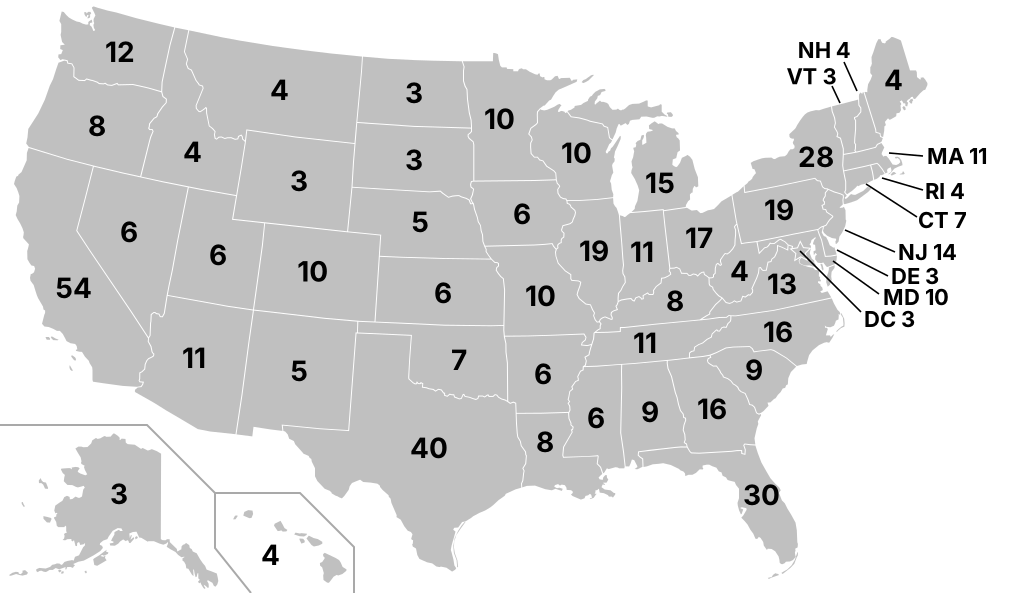
Red tide
Closing the book
Reasonable people understood that the “pandemic” of the Wuhan coronavirus, if it ever reached pandemic levels in the first place, ended around two years ago. Now, however, even the unreasonable people are starting to come to the same conclusion. This week, a federal judge in Florida overturned the ridiculous airline mask mandates, allowing anyone on a plane to breathe free once more. (Now try letting them have liquids!) Everywhere you look, the petty tyrants are desperately trying to hang on to whatever shreds of power they have left in the face of an increasing awake populace.
After an ugly two years, it’s finally looking beautiful again.
That said, there are still those out there who support mandating masks and experimental mRNA gene therapy. If you’re one of them, I want you to admit it, acknowledge it, and own it. After the torture you’ve put us through, you deserve to be proud of what you’re standing for.
Tell every toddler who now has a learning disability or speech impediment.
Tell every woman who has been sterilized and lost her chance at starting a family.
Tell every cancer patient who had to miss the screening that would find their tumor before it was too late.
Tell every grieving man who didn’t get to visit his mother on her deathbed, or hold a proper funeral afterwards.
Tell every couple who had to put off their wedding plans, or who broke up because those plans were never realized.
Tell every unemployed person who lost a job for refusing to go along with your insanity.
Tell everyone who spent weeks or months in the hospital instead of taking a few ivermectin at home and getting better.
Shout it to the world that you don’t care what reason and logic say. You’re still going to harass, coerce, and browbeat until everyone is as full of self-loathing as you must be. And then, when you’ve done that, look at all those faces. Those uncovered faces staring at you with nothing but hatred.
Because we know who you are. We know what you’ve done to us, to our lives. Though the “pandemic” is over, we will not forget.
The death of gaming
Earlier, I was reading a post that struck me as so completely at odds with my view of reality that I felt I had to say something. Since I’m not allowed to make comments at that site (they have a ToS that infringes far too much on the basic right of free expression for my liking), I’ll do it here.
To start, the tone of the post goes beyond breathless, and is difficult to describe without resorting to sexual metaphors. The author is known to be a total Valve fanboy, yes, but this is overboard even for him. In my opinion, it’s the culmination of years of increasing worship of a certain corporation, and that’s honestly sad to see from someone who claims to be a supporter of Linux, an operating system whose very nature is to be free of corporate chains. (Sure, we don’t always live up to that. Gnome and systemd are perfect examples. But even they have their detractors, myself included.)
However, it’s not merely the open admiration of one of the most anti-consumer companies around that is the problem. No, my true concern is that gaming on Linux is dying everywhere. I fully expect 2022 not to be the Year of Linux Gaming, but the end of it, at least for me.
Going out of business
The biggest factor, as I see it, is that it is getting harder and harder to buy PC games at all. With the effective death of physical copies, our only recourse is downloads, and these come with a host of problems. Worst of all, choices for the Linux user have been narrowed to three, all of which are horrible.
-
GOG is a great storefront. I’ve used them for years, and my only complaint in terms of actually buying from them is that my credit union absolutely hates the idea that I’d spend my money on a Polish website using a payment processor based in Cyprus. If you want to actually buy a game, they’re still the best option by leaps and bounds, because they remain (mostly) committed to their pro-freedom stance of only selling DRM-free games. But that commitment doesn’t extend to supporting DRM-free operating systems, and GOG’s parent company is actively hostile to Linux as a gaming platform. With their expected downsizing later this year, it’s clear that the writing is on the wall.
-
Steam is the 800-lb gorilla of the PC gaming space, of course, and it’s hard to overstate their anti-consumer policies. They don’t sell games; you’re merely leasing them, and your ability to play what you’ve purchased always exists only at Valve’s whim. They’ve been successfully sued in multiple countries for violations of basic consumer rights. You have no option but to use their DRM-encrusted marketplace to get your games, even if a few of them graciously allow you to run them in “offline mode”, where your every movement isn’t tracked. Literally the only positive Steam has is its library, because they are in the same monopoly position for gaming that Windows occupied in the OS realm for two decades.
-
Itch.io is the third-party candidate…except for the part where they fit snugly into one of the major parties’ platforms. Don’t get me wrong. They have some great ideas, like adjustable revenue sharing and simple browser downloads. They’re genuinely more open than GOG or Steam. But their downfall, like so many otherwise decent platforms, comes from embracing woke ideology. Itch was very vocal in their disdain for Valve’s minor step towards free speech in 2020. Their biggest bundle to date raised money in support of a terrorist organization, and their biggest category for games is still half-finished visual novels intended for the alphabet soup crowd. As great as their innovations may be, Itch will never be a place that deserves any right-thinking American’s business, and the next great game surely won’t come from there.
Of the minor players in this arena, there’s not much to say. Most are nothing more than Steam resellers. Even Humble Bundle, once a great source of interesting and fun games, has gone that route, adding a dose of Itch’s ideological idiocy on top of that. Epic’s store is anti-Linux, and partially owned by the CCP; while Microsoft’s only suffers from the first of those problems, it’s obviously a very big one. EA and Ubisoft aren’t worth your time even on consoles. The rest are niche options like DLsite, not general-purpose gaming storefronts.
Hardware
The Steam Deck technically isn’t vaporware, I’ll admit. In reality, though, it’s hardly an option for most people. For one thing, nobody can even buy one at the moment. Even if you could, however, you have to do it through Steam. That should already be a no-go for anyone who actually cares about using Linux. Then, you add in the closed hardware—the controller only works if Steam is running, for example—and what are you left with? Not “the power of a PC in the palm of your hand” or whatever, but little more than a modern-day Game Gear that doesn’t need cartridges. (By the way, it runs Arch. Well, except that it doesn’t. It runs SteamOS 3.0, which just happens to use Arch underneath. You know, instead of something sensible and Debian-based.)
Despite all its flaws, this is our best option for a Linux gaming handheld, and purpose-built systems of any other kind don’t look much better. Android games are a disaster, as anyone who has looked at the Play Store’s trending lists can tell you. And it doesn’t get better as you go up in size. In 2022, Linux on laptops is still the same throw of the dice that it was in 2002. System76, the cream of the crop in Linux-using hardware, has a failure rate of 100% this year in my household; my brother has now been waiting a month for his warranty repair, and that’s after I needed almost three weeks for my replacement. The desktop is mostly safe, but video drivers offer you the choice of a rock or a hard place. Do you take Nvidia’s proprietary drivers that can drop support at a moment’s notice, or AMD’s open drivers that will never receive the same level of support from game devs?
The last hope
Now, there are still bright spots in the gaming landscape, although they’re few and far between. Open-source games are slowly getting better on the whole. (As one example, I’ve recently become engrossed in Cataclysm: Dark Days Ahead.) Some of them are original, some are derivative. Some, like OpenTTD, are reimplementations of games so old that they’re from my childhood. One thing you can be sure of, no matter which one you’re playing, is that you’ll never have to worry about a faceless corporation telling you to stop.
Even if you can’t get the full source, there are still a few great games being made by developers who genuinely care about their fanbase, and are willing to do the selling themselves. Rimworld is a good example here; yes, you can buy it on Steam if you’re so inclined, but why not go straight to the maker? While it certainly would be better if these games were free and open, they’re far better than the DRM-filled dystopian alternative.
If all else fails, there’s always emulation. While we could argue about the “dangers of piracy” all you want (speaking as a content creator, it’s a net plus for everyone involved, except marketing and other middlemen), the simple fact is that every “retro” game is readily available, and readily playable on any remotely modern PC. These are the games we grew up with, the ones that trigger the strongest feelings of nostalgia in us, and they’re valuable for that alone. But then you add in the knowledge that you’ll never need a day-1 patch, never have to worry about being banned because you said a bad word, never have to listen to the devs crying about social justice and other make-believe nonsense, and you realize that gaming back then was just plain better, even if the games themselves usually weren’t.
As a Linux user, that’s really where I stand. I see 2022 as the beginning of the end for my preferred kind of gaming: single-player, offline, playing games that can’t be taken away from me, and that treat me like an adult instead of a toddler to be groomed. There aren’t a lot of those left, and it’s becoming harder and harder to find them.
If GOG stops supporting my operating system, I’ll still buy from them on occasion, but only after I’m absolutely certain that the games run under Wine or some similar emulator. Lutris, Bottles, and apps of that sort are helpful in this endeavor, and I believe all but the most hardcore Linux fans should have at least one of them ready to go.
If the last gaming holdout against the creeping plague of “you’ll own nothing and be happy” shuts down completely, on the other hand, I realize I don’t have a lot of options. I already don’t care about AAA titles, so the only ones who lose in that situation are the indies who will no longer have a chance to get my money.
I’ll still have old games, though. And I don’t just mean the SNES-era classics. I’m talking about games that are a few years old, but remain very much playable. Think Stardew Valley, for instance, or Sunless Skies. I bought those on GOG, so I know my downloaded copies will work as long as I keep them. While I know I can only speak for myself, I believe they’re enough to last me the rest of my life.
It didn’t have to be this way. But the Linux community made a deal with the devil, and doing that is only ever going to leave you burned. Alas, Steam is something akin to a cult, and its true believers will never realize the harm they’ve caused.
Requiem
Music has the power to stir the soul. A song can change our mood, can push our emotions to new heights. Never is that more true than during those times where we are already emotional, whether from joy, grief, or somewhere in between. I’m often moved to tears by music, and I feel that everyone should admit, at least to themselves, that it’s possible for them to feel the same.
Over the past few years, I have shared some of my favorite songs, albums, and musical stories on this site. On this dark night (I write this shortly before 1 AM) I would like to do so again, but this time for a different purpose. I don’t intend for you to listen to these four songs because I said so. No, I’m telling you that a day will come when they will be played for me, and I won’t be there to listen. Whether the time until that day is best measured in months or decades, I can’t say. I know that they have summoned some of the strongest emotions I’ve ever felt, so I want them to be heard at the one time I’m certain people will be emotional because of me.
These are in no particular order. I know they also don’t exactly go together, but I’m a complex man. I have many facets. Not all of them meet at straight edges.
One
Avantasia – “Cry Just A Little” (Youtube link)
One of my favorite bands, and one of my favorite stories told through music. I’ve talked about The Scarecrow before, and I devoted considerable space to this song. But that’s because it deserves every word of praise I can give. It’s hard to do a metal ballad right. It’s even harder when that ballad also has to tell the story of a man rejected by society and willing to sacrifice his very soul for one shot at the life and love he dreams of.
The nameless protagonist begs not to be loved—he believes himself unworthy of that—but simply to be acknowledged. Why don’t you at least lie and say that you care, or that you even know I’m there? Believe me, I’ve been there many times. I don’t believe in the existence of demons or devils, unless you count the evil men and women of the world. There have been times, though, that I wished I did, if only to make the same offer of myself.
It’s not about love or fame or wealth. It’s about being remembered. It’s about having someone who cares enough to remember you. Too many people don’t have that, and I often wonder if I’ll number among them when the time comes.
Two
Breaking Benjamin – “Dear Agony (Aurora Version)” (Youtube link)
I specify the Aurora version of this song solely because of Lacey Sturm’s angelic vocals. “Hauntingly beautiful” is a phrase I use too often, but it’s very appropriate here.
Again, I’ve mentioned this song before on here. I’ve used it as a post title, added in the lyrics, and referenced it multiple times. I’ve dreamed myself and the woman I love singing it together. That’s how much it has affected me in the scant two years since its release.
I live each day in pain. I have for years. I don’t always let it show. Even my closest loved ones never know the true extent of it, because I learned long ago that few people want to hear about depression, and even fewer want to help in a way that relieves the agony for one precious moment.
A song about fighting with each breath until the pain finally does stop, until you reach that final moment where you know you’ll never have to feel again, that speaks to me. Coming from an evangelical family, I often heard my elders say of the dead, “At least he’s not hurting anymore.” As a child, I never truly understood that. As an adult, I certainly do.
Three
Anders Osborne – “Higher Ground” (Youtube link)
To speak further of pain, this song might be that feeling personified. The last time I listened to it was in January 2014, the night my cousin died. To this day, I can still recall the anguish of that cold, dark evening. I couldn’t bear to look at him, so I stayed with my grandmother. I locked myself in her bedroom, threw my headphones on, queued up Black Eye Galaxy, and just cried.
The singer was dealing with addiction (probably heroin, considering “Black Tar” is the name of another track); that’s what the whole album is about. But the message of this closing track is universal. We all want to find that higher ground, that way of rising above the aches and pains of earthly living. For those of us who aren’t religious, it’s much harder. We lack the comfort and certainty that come with faith. We can’t be sure, and that’s scary.
Once again, I have to refer to my family. As far as I can tell, none of them have ever had to struggle with that kind of doubt, and that means it’s something I can’t share with them. I can’t talk about it to those I’ve known the longest, because we’re so far apart on the matter that we just talk past each other. And that only feeds into my perception of being alone. In this case, I really am.
Four
Allman Brothers Band – “Will The Circle Be Unbroken (Live)” (Youtube link)
Despite what you might think, this is technically not a religious song; it was originally written for a secular purpose, and the religious trappings were added later.
I’m a Southern man. Always have been, always will be. And this is a Southern anthem, part of that collective unconscious we share as a culture. Especially when it’s performed by one of the culture’s greatest acts.
Really, what else is left to say? I love who I am, where I live, the people I’m able to call neighbors. There’s no other part of the country or the world that I’d rather make my home. While I can’t share in every part of what it means to be a Southerner, this is a common ground, a place in the middle where I’m willing to meet. And it encompasses all of the themes I’ve been trying to speak here. The pain, the grief, and the hope of something better for someone, if not myself.
We all need to let these things out from time to time. For me, music gives voice to the thoughts I find so hard to speak. I want that to be true for as long as I live, and even beyond.
