Novel month 2020 – Day 7

Today’s word count: 2,166
Total word count: 10,632
Daily average: 1,518
Projected total: 45,565

Into Chapter 1 now. For Orphans novels, that means back to rotating POVs, which really makes things a lot easier. And we start out with a lot of exploration. I love exploration. I swear, I could write an entire book like that. No real action necessary, just people exploring a new land, finding things no one has seen before. Maybe nobody else would read it, but who cares?

Novel month 2020 – Day 6

Today’s word count: 2,251
Total word count: 8,466
Daily average: 1,411
Projected total: 42,330

Much better. The prologue is finished, and Sora had her time to shine. I will admit that this is the first time in Orphans that I’ve used outside input to direct the story. My brother read Innocence Reborn a couple of months ago, and he said Sora was his favorite character, despite the fact that she only really featured in about five scenes. So, when she became one of the finalists for the On the Stellar Sea prologue POV, I really had to give her the role.

Novel month 2020 – Day 3

Today’s word count: 618
Total word count: 5,227
Daily average: 1,742
Projected total: 52,270

Stopping very early because I’ve been told the voting lines are long. Fingers crossed that we get some good news tonight.

And a note: I’ve had some serious phone issues this week. If you’re trying to reach me (or wondering why I haven’t reached you), bear that in mind.

(Update: Miscalculated the projected total. I guess I should apply for a polling job at Fox News.)

Novel Month 2020: Ready to rock and roll

Happy Halloween, everyone. I hope you’re out there playing tricks and getting treats. Or just out there in general, because life’s too short to be scared of a virus with a 99.87% survival rate.

Another November is upon us, and that means it’s yet again time for the big writing push that is Nanowrimo. This will be my 10th attempt, and what I hope to be my 9th straight successful year. As always, the “official” goal is an original novel of 50,000 words, but you know I play by my own rules. Either/or, in this case. If I get to 50K without finishing the book, I’ll consider it a victory. If I get to the end of the story first, well, I’m not going to pad it just for the sake of numbers.

As always, here are my previous successful attempts:

  • 2012: Heirs of Divinity
  • 2013: Out of the Past
  • 2014: Before I Wake
  • 2015: The City and the Hill
  • 2016: Nocturne
  • 2017: The Soulstone Sorcerer
  • 2018: Seasons Change
  • 2019: Winds of Change

Three of these have since become part of my Otherworld series; a fourth, Seasons Change, is a kind of side story. Heirs of Divinity is my perennial “I’ll get it out eventually” novel, and I’ve been giving you that lie for about 4 years now. I put The Soulstone Sorcerer on my Patreon a few months back. And Before I Wake, of course, was my first self-published book, and you can still get it on the Kindle Store. It’s a lot rougher than my present works, but I remain proud of it.

That leaves Nocturne, and I want to talk about it just a little bit before I get into 2020’s entry. Nocturne came about because of two events. First, the Great American Eclipse of 2017, which I had the good fortune to watch from my driveway. I planned for almost two full years before the big day (which was, coincidentally enough, my father’s 55th birthday), and those plans influenced my thoughts often in the intervening time. So, one day in October 2016, I was taking a shower, and I had a thought. Eclipses are considered omens in many cultures, but what if they actually factored into a magic system? The rest is history.

November 2016, though, also had an event that could not be ignored, and that’s why Nocturne keeps coming to mind now. As we all know, that was the last presidential election. Well, the time influenced me greatly, bleeding into the story in a way I’ve not done since. Some parts of Nocturne are absolutely allegory. Maxon, for instance, represents the extremists who are once again wreaking havoc on our cities, while Aures, the conniving businessman who comes out of nowhere, plays both sides against one another, and takes power in the ensuing confusion, has a fairly obvious real-world counterpart.

I never expected that novel to continue being culturally relevant four years later, but here we are. To this day, I maintain that it is my greatest work. Never mind that I wrote the first draft in 7 weeks, and parts of it were practically on instinct. To me, it stands as my highest literary achievement.


But I want something different this year. I’m tired of politics. It’s politics that stole the past 8 months of my life (and counting). It’s politics that sent me into new levels of depression in April. And July. And a couple of weeks ago. So let’s find something else.

The original plan, such as it was, revolved around Otherworld #20. (Actually, it should be considered Otherworld #32, but…reasons.) I had a few plans for it, and I just finished the previous entry this week. so it seemed a natural fit, except that I started getting the feeling that it would be too political. The metaplot for the third Otherworld “season” is a succession crisis. I know I wouldn’t be able to stop myself from inserting references to this year’s election. As the whole point is to avoid that as much as possible, I shelved the idea. Otherworld #20 can wait until next year, because I’ve already decided that 2021 will not see new releases of the series.

So what am I writing, if not that?

Readers of my Patreon status updates will know that I finished the draft for my fourth Orphans of the Stars sci-fi novel, Time in the Sun, earlier this month. It was a climactic moment for many reasons, not the least because it was my 60th completed story. I’d planned this series to span at least 8 books, possibly 9, but I don’t have any notes on what’s to happen in future books. All I did have was a vague idea of where it would begin, and a title: On the Stellar Sea.

That will be my Nanowrimo entry this year. Orphans of the Stars #5, On the Stellar Sea. I very seriously doubt I’ll finish the entire novel in November, as my initial estimate would be around 120,000 words. (Shut up, 2017!) If I can get 50K in the next month, I’ll gladly call that a win. If I reach the end by December 31, even better, but we’ll call that a stretch goal.

If you’re playing along at home, I’ll close out with a variation on my sign-off catchphrase: Keep writing!

Summer Reading List Challenge 2020: The also-rans

(I never did write this, even though I promised it two months ago. Here goes.)

Through the summer, I challenged myself to read three new books, including at least one in a genre I don’t normally read or write. You can see in my earlier posts (part one and part two) that I did complete this challenge. Humble Pi, Northumbria: The Lost Kingdom, and even Verity were all interesting works. I learned from all three, whether it was how to avoid common math errors, the history of a very interesting place to which I have a very slight ancestral connection, or just how to be a better author.

These were not, however, the only books I tried to read. As I stated in “Politics and the escape”, I attempted to read two others during the summer. These books I found interesting to start, but I was quickly turned off by the nuisance of politics—particularly politics I strongly oppose—shoved into otherwise decent works of nonfiction.

So here are my thoughts on those abandoned entries in the challenge.

A hopeless history

Title: Humankind: A Hopeful History
Author: Rutger Bregman
Genre: Sociology
Year: 2020

Bregman is, from what I gather, a bit of a media darling. He’s one of those random Euros who doesn’t really do much, but gets invited to TED talks and things like that because he says what some people like to hear. And the description of Humankind does sound inspiring. It’s supposed to be all about how humans have evolved to be fundamentally good and social, which is true.

What isn’t true, however, is the dichotomy the author paints. It’s a rotten foundation for a book that could have otherwise been great for everyone. But Bregman sets up the argument that society must choose between Rousseau’s “return to nature” and Hobbes’ Leviathan. Your choices are green socialism or authoritarian socialism.

This is a common theme in European politics, and it’s one of the fundamental disconnects between that entire continent and the United States. In the European view, individual liberties are always subservient to the nebulous idea of the public good. That’s why they have things like GDPR, burqa bans, and “hate speech” laws, while we in America have barred such measures in one of our founding documents.

But in Bregman’s world, there’s no room for libertarianism, or indeed liberty at all. In his view, people can only progress by working together under the strictures of a state. Because we’re too dumb to care for ourselves. No, really. He spends an entire chapter claiming evidence that humans have evolved to become stupid as well as social. We’ve “domesticated” ourselves, and mentally we’re no better than puppies. This, of course, ignores the individuals who have, because they were individuals, changed the world. Tell Einstein or Newton that they could have done more if they’d only made more friends.

I didn’t finish Humankind, as I was so disgusted with this unending statist screed that I had to put it aside. Supposedly, the last part of the book sketches a new vision for the future, centered around things like basic income and open borders. A restatement of another of the author’s books, and one I obviously can’t endorse. Not because I’m against such notions—I think a universal basic income system could work, for example, but only if done properly—but his version of utopia strikes me as very dystopian. In the great social future, there’s no room for individuality or personal growth or opportunity. It’s the extreme opposite end of Franklin’s famous quote: those who sign on to this vision are giving up all liberty in exchange for the safety of never having to make their own decisions.

Huh. I guess those people are like puppies.

Treason of thought

Title: The Contact Paradox
Author: Keith Cooper
Genre: Science/Astronomy
Year: 2019

This is another one I went in really wanting to like. I’m a space enthusiast, to put it mildly, and SETI has always fascinated me. So when I saw a book that claimed to challenge “our assumptions in the search for extraterrestrial intelligence,” I had to check it out.

Indeed, there’s a lot of good science in this text. It shows how our current SETI approaches ignore a vast search space. The reasons we do that, of course, are all financial, not from a lack of technology, knowledge, or will. And The Contact Paradox doesn’t really address that.

In fact, one section places the author squarely against increasing SETI spending. And, indeed, spending on any kind of science. A section on environmental matters, beyond preaching the usual global warming dogma, insults those of who choose to look at the evidence themselves, calling skeptics “traitors of humanity” whose opinions aren’t even worth arguing against.

I’ve had emotional reactions to books before. A few novels have made me cry. Some left me feeling a sense of enlightenment and inner peace. Nonfiction doesn’t normally inspire the same emotions, but it can; anybody who saw the 50+ pages of notes I took for my CBT workbook could detect the gamut of emotional responses. Never before, though, have I felt such a visceral anger at an author for the words he wrote. I immediately closed my reader app, and the only reason I didn’t delete the file was because I wanted to remember the name of it, in case I ran into it again and thought about reading it.

We skeptics are not the traitors. Far from it. We are the ones following the scientific method. The alarmists who claim the Earth will become uninhabitable within the decade unless we stop driving, stop using plastic, stop eating red meat, and essentially stop doing anything productive at all, those are the true traitors. They are the ones standing in the way of humanity’s progress. Without them and their cult-like mentality, their constant denigration of those they consider heretics and apostates, we could solve the actual problems facing us today.

It’s the opposite problem to what Bregman runs into, if you think about it. In Humankind, the stated assumption was that humans have become lesser. We’re not as smart, on the whole, as we should be. And his thesis is that this stunting of our mental growth means we need a strong state supporting us, because we’re just too dumb to be left alone.

Cooper, on the other hand, echoes the alarmists’ claims that we need to become lesser. That progress needs to come to a screeching halt, if not a total reversal to the nasty, brutish, and short lives of agrarian societies before the Industrial Revolution.

What both authors share is the anti-individual mentality that has seeped into every part of our modern culture. In this view of humanity, no man is an island, as the saying goes. Instead, we must all be chained to the mainland, never allowed to ask the question, “What’s beyond the horizon?” It’s a limiting view, but I posit that this is by design. By keeping us small and scared, these people believe they can keep us controlled.

No dreams of becoming better than we are. Those can’t be allowed. Creativity and imagination must only follow prescribed lines, as well. It’s cultural thought control on a level even Orwell couldn’t imagine. And authors such as Bregman and Cooper are supporting it. They’re enabling it.

When I write a novel, I do it to escape. I do it to imagine a world that isn’t necessarily better than ours, but one which is different enough to be interesting. Some of them include my vision of utopia, yes. Every author does that. What I don’t do is claim my vision is the only one allowed, that anyone who disagrees is not only wrong but heretical. That’s not the point. I’m not writing a persuasive essay or political tract. I’m telling a story.

And in my stories, the people who try to control others are rightly considered the villains.
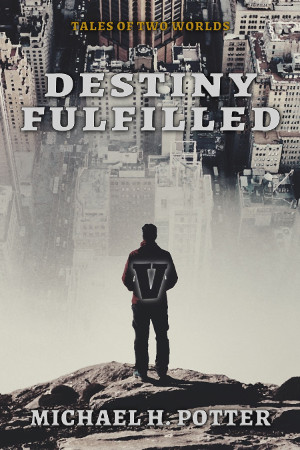
Release: Destiny Fulfilled (Tales of Two Worlds 5)

We’ve come a long way. Some of us more than others. And in the case of two characters from this installment of Tales of Two Worlds, the distance is unimaginable.

For some, the other world is home, and ours is the alien land. A man on a mission discovers that the land he believed a paradise is instead something else entirely. His sister, happy in the life she has made, fears for him, yet she wants him to experience the same wonder she had a year ago. And her husband would gladly forget about the other world altogether, but he knows he can’t. The bonds of family are strong, even when pulled to their limit.

Since it’s an Otherworld story, you know it’s exclusive to my Patreon. And you know it only costs you 3 bucks a month to pick it up. So I don’t need to say that…except that I already did.

Well, no matter. The next in line is also the last. Tune in this November for the Tales finale, “The Price of Freedom”. Until that day comes, keep reading!

Politics and the escape

Seems like we can’t get rid of politics these days. It’s an election year, combined with a manufactured crisis, a race war, and whatever else is going on in the world. No wonder stress-related health problems have skyrocketed in 2020. Not just for me, but for the whole country.

In times of trouble, when the real world is an awful place to be, I normally turn to fantasy or science fiction. Some people have other escapes, but my strongest has always been my imagination, aided where necessary by the words of “genre” fiction authors. The past decade has allowed me to make my mark, and I have consistently stated that I write what I do because I am, at heart, an escapist.

But it’s getting harder and harder to avoid the thorny political problems of the world around me by diving into a novel. That isn’t because I’m having trouble reading. Oh, no. Since being placed under effective house arrest in March, I’ve read more than a dozen different books. Most are nonfiction, history or science books that caught my eye. A couple were fiction, part of my ever-growing “books to read” pile.

I have others in that. I started reading Brent Weeks’ The Burning White this week. Blood of Empire (Brian McClellan) still waits. The Infernal Battalion? Still untouched. And so on.

Why haven’t I been reading as much speculative fiction? If you asked me a while back, I’d say it was because I didn’t have enough time. Or I didn’t feel like committing to it. Those are both lies, of course. I’ve got nothing but time. I have no problem rereading my own novels. I don’t mind checking out an archaeological history of England, a humorous account of mathematical errors, or a study of idioms originating in the King James Bible.

No, my present problem with fantasy and sci-fi boils down to politics. As part of my treatment for depression and anxiety, I’ve been tasked with a series of introspective exercises, and those have helped me come to terms with this.

In a nutshell

It isn’t politics per se that turned me off fantasy. I don’t mind a novel with political wrangling, as long as there’s a good story in there. But I feel like I’ve read all of those. Martin has basically stopped writing. So has Scott Lynch. Jim Butcher needed six years to come up with a new Dresden Files entry, and the reviews I’ve seen of Peace Talks say it’s incomplete at best.

I’m not even opposed to political allegory, if done properly. I mean, I’d be a hypocrite if I said otherwise. My Nocturne, written in November-December 2016, was unabashedly political. (Funny how its themes are still relevant now.) I don’t mind exploring an important topic through the metaphorical lens of fiction.

But there are good and bad ways to go about it. Lately, I see too many authors—prominent, professional authors who really should know better—taking the bad route. It’s one thing to write a character, even a central character, to hold a firm opinion on an issue. I’ve done it often. In my Otherworld series, Ashley starts out as a stereotypical feminist, while Damonte is openly socialist. Martevis, a protagonist of my Hidden Hills novels, might have common friends, but he retains an aristocratic view of social class. The Modern Minds short stories feature a character whose mother is a very…zealous evangelical.

Too often, the pros I once idolized have made the decision not to write characters like those. Instead, they preach. It’s not enough for the characters to believe in a cause. No, the narrator has to believe in it, too, even when that narrator has no connection to them. And the cause has to be front and center at every possible opportunity, whether or not it contributes to the progression of the story.

Most of the examples I see in fiction today are of the leftist bent. As I’ve stated in prior posts, I’m, well, not. “Classical liberal” is the closest label I’ve found to describe my leanings, and it’s far from perfect. But I’m not complaining because I disagree with the politics. I’d say the same thing if the narrative preaching were progressive, conservative, libertarian, authoritarian, anarchist, or any other form you could imagine. (Seriously. Ask me about Ayn Rand sometime.)

No, it’s not that I don’t like what you’re saying. It’s that I can’t stand how you’re saying it. Berating the reader is never a good recipe for success. Beating me over the head with political theory in what was supposed to be a fun, relaxing escape from reality takes away any joy I might have gained.

Illustration 1: The Expanse

It wouldn’t be a PPC post without some illustrative examples, so here’s what I’m ranting about this time. First, The Expanse, by James S. A. Corey. I enjoyed the opening book, Leviathan Wakes. It got me back into space-based sci-fi after a decade away. And the series continued to impress. Cibola Burn had some major plot holes, Babylon’s Ashes was forgettable, but the whole thing was just so fun and refreshing.

In the seventh book, Persepolis Rising, I became thoroughly disillusioned. It was around that point that I noticed there were no stable, monogamous, heterosexual relationships anywhere, except for the villains. Holden and Naomi are content to FWBs. Alex is coming off one failed marriage when the series starts; he adds a second in the 30-year jump between books 6 and 7. Amos is a psychopath who avoids commitment. Holden’s “parents” are a group of seven people who did some genetic trickery to have a baby sharing DNA with all of them—mostly for tax purposes, not because they wanted to perpetuate their lineages.

Yet there are plenty of…alternative arrangements that take center stage. In Abaddon’s Gate, we see a lesbian couple whose names I can’t remember. Babylon’s Ashes has Pa and her polyamorous crew. The only “traditional” family that gets more than a brief mention is that of Duarte, in Persepolis Rising. The megalomaniacal Martian who (spoiler alert!) ends up conquering the entire solar system with the help of alien technology is just about the only man with any serious screen time who has a wife and a child. Earth’s population had somehow reached fifteen billion by the starting point of this series, and I’m left wondering how.

The Expanse’s political browbeating doesn’t stop there, alas. Early books were fairly neutral. Earth has its share of good and bad. Belters very naturally develop a terrorist wing due to their constant persecution. As the series progresses, however, it takes a hard left turn. Corporations are ubiquitous in the setting, but they are rarely, if ever, shown in a positive light. The idea of “consent of the governed” is widely viewed as fringe, if not crazy.

The killing blows, in my opinion, are twofold. Persepolis Rising introduces the new bad guys, and I couldn’t help but imagine the authors (James S. A. Corey is a shared pseudonym) saying, “Why don’t you understand that we’re talking about Trump?” It’s okay to base a foe off an important historical figure, but this is much too transparent. Adding insult to injury is the way essentially every male character has been marginalized or emasculated. In the future, apparently, boys aren’t allowed to have heroes.

Illustration 2: Demon Cycle

Peter V. Brett’s Demon Cycle series is another one I liked to start. The Warded Man was a great book, and I’ve sung its praises on this site before. Brett has a great worldbuilding mind. He can handle dialect, something few others bother to try. And he made a great antihero in Arlen Bales.

It’s everything else that’s the problem. The enemies of the setting are the Krasians, who are best described as Muslim ninjas crossed with the Bene Gesserit from Dune. Arlen’s first meeting with them is as a trader who joins their fight against the nocturnal demons who haunt the world. He leaves in disgrace, beaten and raped, and this seems to be a common theme in the series. Okay, that happened in history. Not so bad, right?

But it goes downhill from there, in my opinion. The patriarchal, indeed misogynistic (and I, unlike your average Twitter user, do not use that term lightly), Krasians are secretly controlled by their women. Their emperor’s wife uses blood magic to control his mind—when sex doesn’t work, anyway. His daughter secretly creates a women-only assassin squad. The whole thing is more full of holes than the official coronavirus narrative.

It takes away from what was otherwise a decent, innovative fantasy series. The whole message at every turn seems to be “White men can’t do anything right unless they’re helped.” Arlen was a prodigy, but he’s about the only one. Rojer comes across as somewhat bumbling, and ends being manipulated by women. Jeph, Arlen’s father, is just plain pathetic. Every other white male character is an oaf, an opportunist, or a cuckold. Meanwhile, the women of the setting rule everything, whether behind the scenes or out in the open.

Go broke

If that phenomenon were limited to a single series in fantasy or sci-fi, I wouldn’t have much to say. I’d just not read those books. But this is pervasive, and it all goes in only one direction now. It’s the same problem Hollywood has. It’s the same problem video games have. Story so often takes a back seat to diversity, yet diversity of thought is never allowed. The good guys must never be just guys, for instance, because that’s sexist. Capitalism always results in dystopia. Religion is only ever tyrannical, unless it’s tribal shamanism, in which case it’s the most powerful force in the world.

But that’s not an escape. If I wanted to read about the black transgender heroine facing off against the evil colonial corporation that’s all-white, I’d just go on Tumblr, or Reddit, or Twitter, or Mastodon, or…you get the idea.

Fantasy worlds aren’t ours. They don’t have our problems; they have their own instead. I’ve written scores of articles about this very thing, but it’s only getting worse. The political cancer has spread into my last refuge. Is it any wonder I’m depressed, or that I’ve switched to reading history and science books?

I don’t care what you believe. If you want to think that communism is great, fine by me. I vehemently disagree, but that’s your right. Think that America should expel anyone who isn’t a white Christian? I’ll oppose you with all I’ve got, but I won’t stop you from expressing your opinion. Until your ideology infringes on my rights, it’s none of my business.

That said, is there any reason to force it into your writing? The answer, of course, is a resounding no. Nothing should be forced. That’s just poor writing. You may pat yourself on the back for making your characters so “woke” that you get all the internet points, but it doesn’t make them deeper. Cardboard cutouts are boring no matter where they fall on the Political Compass.

No, if you can’t be subtle about it, leave the real-world politics in the real world. I didn’t come to your book for a lecture on how awful the conservatives/progressives/whatever are. I came to get away from that.